
- Insights
- Featured Insights
As artificial intelligence (AI) evolves from a speculative tool to a core component of regulatory technology (RegTech), financial institutions (FIs) face a fundamental question: are human compliance teams becoming expendable?
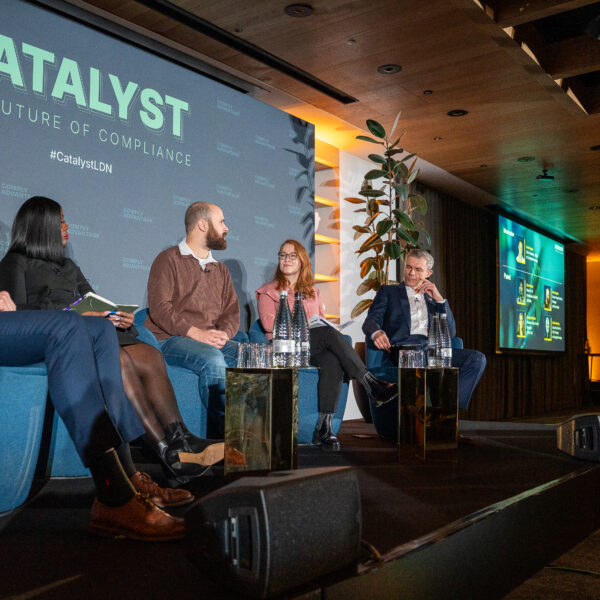
At CATALYST 2025, a panel of experts from Mollie, Monzo Bank, PwC, and ComplyAdvantage gathered to discuss this shifting landscape. Their consensus was clear: the future of financial integrity is not a zero-sum game of “man versus machine.” Instead, the industry is entering an era of “human-led” automation. By integrating AI as a “digital coworker,” firms can move beyond siloed, reactive processes to build a proactive, scalable defense against global financial crime.
Here are five reasons why AI is designed to empower, rather than replace, the modern compliance professional.
1. AI automates the noise so humans can focus on the nuance
Operational leaders have long battled a linear relationship between business growth and compliance costs. Traditionally, to scale a business, you had to scale the headcount. AI breaks this cycle by acting as a high-speed filter for repetitive, low-value alerts.
We’ve seen a shift to a more AI perspective that enables more correct identification of high-risk merchants. This reduces the time analysts spend so they can focus on complex cases.
Dane Pedro, Head of UK Compliance and MLRO at Mollie
By allowing digital coworkers to handle the “signal-from-the-noise” filtering, human teams are freed from the “spreadsheet spiral.” Instead of managing ten different tabs in an inbox, analysts can apply their expertise to high-stakes investigations that require in-depth, contextual analysis.
2. Humans provide the empathy that AI cannot replicate
While AI is exceptionally efficient at classifying financial crime types and drafting rapid responses, it lacks the emotional intelligence required for sensitive cases. The panel highlighted that while AI can identify a “romance scam” or a “vulnerable customer” profile, the actual management of those individuals requires a human touch.
Alex Clayden, Senior Financial Crime Manager at Monzo, noted that certain processes, such as those involving refugees or customers in shelters, require a level of “human care” that a machine cannot simulate. AI acts as the supportive infrastructure – spotting the pattern of a scam in seconds – but the human remains the essential layer of care that protects the customer relationship and the firm’s reputation.
Catch up with all the keynote speeches, fireside chats, and panel discussions from Catalyst. Hear exclusive insights from our expert speaker lineup on-demand.

Watch all CATALYST sessions on-demand
3. Critical judgment is required to fight crime-as-a-service (CaaS)
The threat landscape is becoming “democratized.” Criminals can now purchase $40 ransomware kits or utilize generative AI (GenAI) to translate scams into languages like Japanese, which previously had low fraud rates due to the language barrier. To fight an AI-literate adversary, firms need an agile defense that combines technological precision with human intuition.
We found new and creative ways to enable staff to use their brains to make more complex decisions faster. We won’t use AI to replace people, but rather to overcome low-value alerting and replace repetitive tasks.
Alex Clayden, Senior Financial Crime Manager at Monzo
Precision is the “killer feature” here. If a model is tuned poorly, it might disadvantage a thousand honest customers to catch three bad actors. Human experts are necessary to fine-tune these models, ensuring they are surgical in their accuracy rather than “burning down the haystack” to find the needle.
4. Accountability and governance must remain human-led
A major theme at CATALYST was the shift in the regulatory landscape from gatekeeping to enablement. In the UK, the FCA is now utilizing “live sandboxes” to facilitate experimentation by firms. However, even with these advancements, regulators still require human accountability.
The success of any agentic system depends on human-led governance. This includes ensuring explainability: if a human cannot explain why an AI made a specific decision, the institution cannot remain compliant. As the panel noted, “we should treat AI agents like new employees” – subjecting them to probationary periods, continuous oversight, and performance reviews to ensure they are operating within the firm’s risk appetite.
5. Modern compliance professionals are becoming “AI managers”
The role of the compliance officer is evolving from a data processor to a strategist. The panel compared the current AI shift to the arrival of email decades ago: firms didn’t hire “Chief Email Officers”; instead, the entire workforce learned to use the tool to work faster.
Do the right thing by your staff and give them learning paths that set them up for the world that’s coming. Financial crime compliance in 10 years will look very different from today.
Iain Armstrong, Executive Director, FCC Strategy at ComplyAdvantage
Instead of spending hours on manual data entry, the modern professional oversees a “constellation of technologies,” using AI-native platforms to unify data and direct AI agents toward the most critical threats.
Move toward a human + agentic compliance model
ComplyAdvantage Mesh provides 24/7 automated case remediation, freeing compliance teams from low-risk tasks and escalating only ambiguous cases, ensuring human expertise is focused on issues that require intuition and moral judgment.
Get a demoOriginally published 22 December 2025, updated 27 February 2026
Disclaimer: This is for general information only. The information presented does not constitute legal advice. ComplyAdvantage accepts no responsibility for any information contained herein and disclaims and excludes any liability in respect of the contents or for action taken based on this information.
Copyright © 2026 IVXS UK Limited (trading as ComplyAdvantage).