

- Insights
- Featured Insights
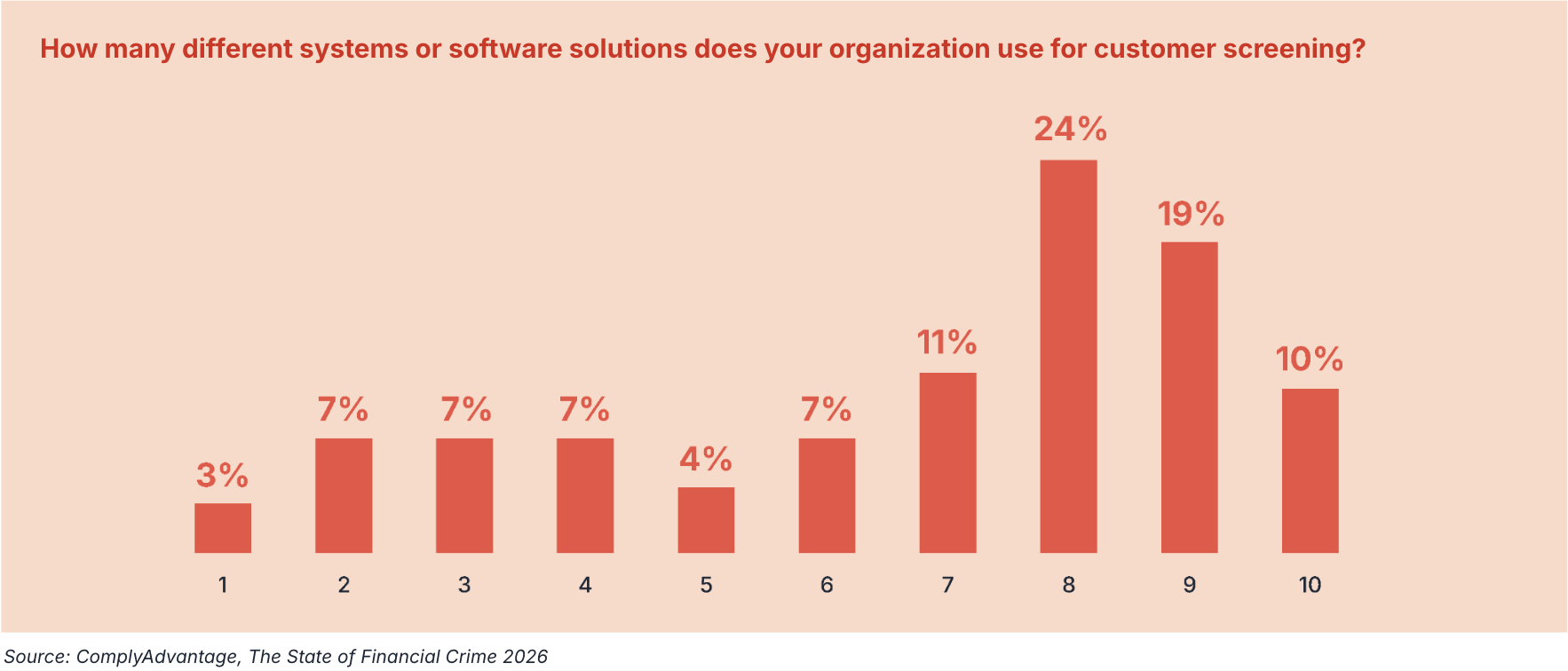
Our survey data was clear: the vast majority of firms are stuck with a multi-solution compliance sprawl, but nobody’s happy about it. Specifically, 97% of our State of Financial Crime 2026 survey respondents reported using two or more solutions, and more than half (53%) used eight or more for transaction monitoring alone.
Yet a full 100% of our respondents said a single anti-money laundering (AML) interface would be helpful.
It makes sense. Having to jump between multiple platforms to monitor transactions renders a clear view of the story behind the data virtually impossible. To piece anything together at all, analysts have to constantly switch between tools and individual account views. This fragmentation creates significant operational drag and increases the risk of analyst fatigue, where the sheer volume of repetitive, manual tasks undermines the quality of human judgment.
Need to find out if this account’s spending pattern was repeated elsewhere? Reach out to the data team and have them pull a report manually.
Want to find out if that address is associated with nefarious activity? Individually search internal databases, request reports, and search the internet for connections.
Having to do this forces teams to make an impossible decision: spend so much time on individual alerts that they have to cut corners on others, or cut corners on all of them to meet a quota. Policy usually demands the latter unless the case for a deeper investigation is cut-and-dry (if then).
Meanwhile, the mentally demanding work of manually piecing together information from unconnected tools takes its toll. Decision fatigue sets in, and analyst judgement quality tanks. This isn’t just inefficient; it’s a recipe for burnout, turning skilled investigators into data entry clerks.
Clearly, something must shift. Our survey shows firms are ready for a better solution, even if they haven’t made the leap yet. They intuit that if a multi-solution sprawl hinders efficiency, decision quality, and consistency, a centralized view can improve all of these things.
4 benefits of integrated AML insights
What if most of these problems could be solved by integrating financial crime intelligence for a holistic risk view? Below, we explore 4 clear benefits of centralizing your AML intelligence.
1. Investigations take less time
Analysts eliminate transition time between interfaces when they can see all the relevant intelligence in one place. They also don’t have to wait on other teams to send the information they need to investigate. Less legwork is then needed to piece the information together into something cohesive, especially if the integrated solution includes agentic AI capabilities that can connect some of the dots faster. This efficiency allows centralized compliance workflows to scale better, too.
2. Analysts see more data
Because all the data is in one place, analysts can see more of it in the same period of time. They also see more clearly: pieces of information that would have been overlooked take on new meaning when they’re sitting in their native context. A centralized platform also eliminates a core cause of decision fatigue and blind judgment calls.

The State of Financial Crime 2026
Get insights on financial crime trends from our global survey of 600 senior decision-makers and expert guidance from our Financial Crime Compliance Strategy team.
Download now3. The data tells a clear story
Data always tells a story, but whether that story is discovered is another question.
Is the client who made the alerted transaction connected to the ultimate beneficial owners of the firm the money went to? Is there evidence they have a history of interacting in other ways? What other activities are the firms and people connected to this transaction involved in?
These things can be completely missed if the data is scattered across platforms with no way to find it or see how it all ties together. But when it’s all visibly connected in one place, it’s easier to piece telling narratives together.
4. More crime reported – fewer false alarms
Integrated data empowers analysts to uncover more crime and spend less time on wild-goose chases. This leads to a stronger compliance posture, which helps protect the firm from regulatory penalties for overlooked money laundering. At the same time, it drives better return on investment (ROI) by making existing resources more efficient and turning compliance from a cost center into a strategic advantage. When the goal is to enhance risk management and improve ROI, the decision is clear: consolidating AML systems is the smart move.
While the advantages are clear, the path to achieving them has its own set of challenges.
Moving to integrated financial crime intelligence
The case for AML intelligence consolidation is clear, and our survey respondents agreed. In fact, 99% also believe integrating the entire AML process – from screening to monitoring – through a single integration would be useful. Yet, as of today, none of the respondents reported having a single interface that presents all the insights they need.
Why the discrepancy?
Trouble gaining approval for AML modernization can be a significant roadblock. Decision-makers can be impeded by concerns about upfront costs, uncertainty about complicated transition periods, and worries about new, unknown technology and the learning curve to full adoption. However, these roadblocks are not insurmountable.
A new era for compliance
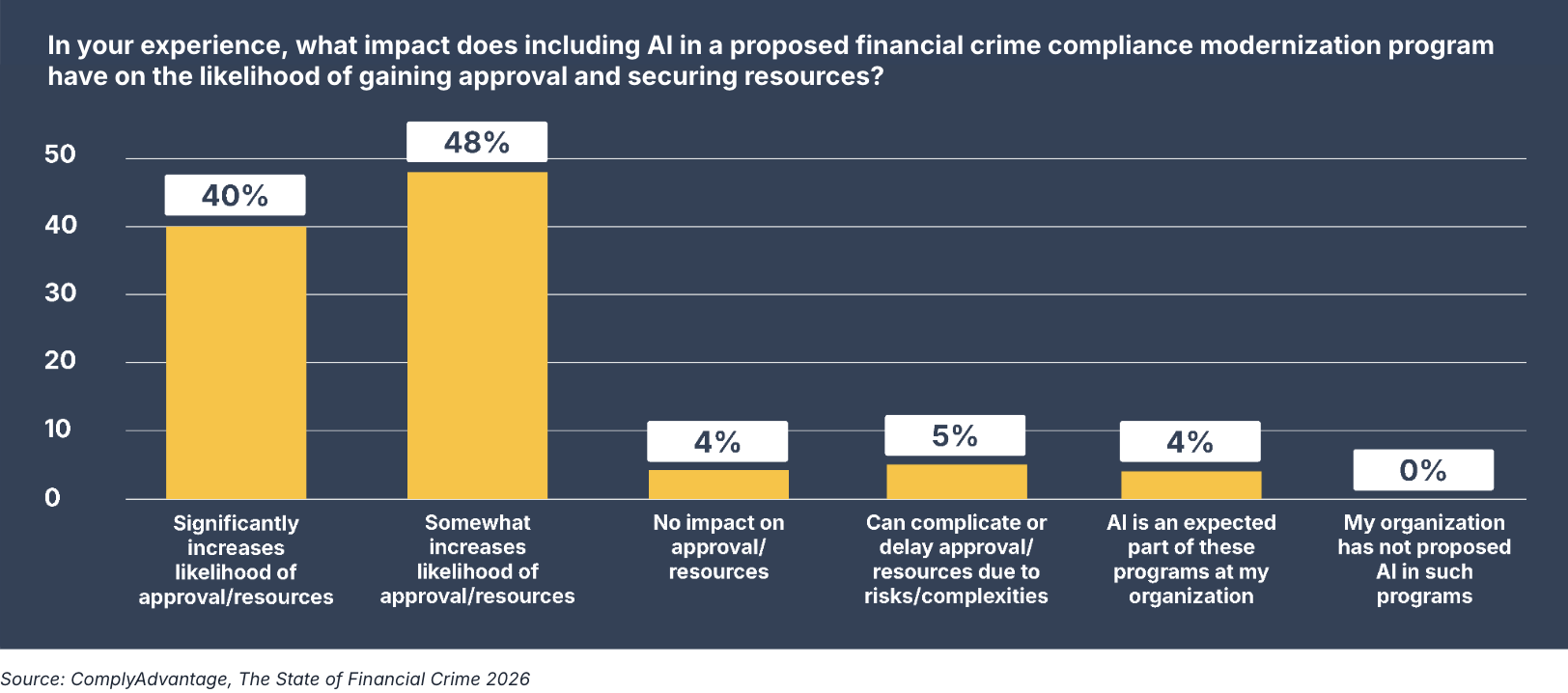
Our survey highlights a clear path forward. With 88% of firms agreeing that including AI in a modernization proposal increases the likelihood of securing resources, it’s clear where leadership appetite lies.
This creates the perfect catalyst for solving the software sprawl that plagues compliance teams. The solution isn’t another tool bolted on to a broken architecture; it’s a fundamental shift to an AI-native platform.
When AI is built in, not bolted on, it’s designed from the ground up to unify the entire compliance lifecycle. It transforms disparate data from screening, monitoring, and payments into a single, holistic view of risk within a single intelligent system. The business case, therefore, is not about a painful consolidation project. It’s about adopting an AI-native platform where consolidating systems and eliminating noise are core functions, not afterthoughts.
This is how compliance teams move faster and with more confidence. It’s how they turn a reactive cost center into a strategic catalyst for growth. By moving to an integrated model, organizations move beyond the friction of siloed data to achieve a holistic view of risk that serves as a catalyst for operational resilience and confident scaling.
Discover integrated AML compliance with Mesh
A cloud-based compliance platform, ComplyAdvantage Mesh combines industry-leading AML risk intelligence with actionable risk signals to screen customers and monitor their behavior in near real time.
Learn moreOriginally published 03 March 2026, updated 03 March 2026
Disclaimer: This is for general information only. The information presented does not constitute legal advice. ComplyAdvantage accepts no responsibility for any information contained herein and disclaims and excludes any liability in respect of the contents or for action taken based on this information.
Copyright © 2026 IVXS UK Limited (trading as ComplyAdvantage).