
- Insights
- Featured Insights
The global public sector loses trillions of dollars annually to a “scamdemic” – a massive scaling crisis of financial crime (FinCrime) and cybercrime. To navigate this crisis, industry leaders like Lord Chris Holmes of Richmond advocate for a shift away from reactive, siloed defenses toward a “human-led” alliance of advanced technology, modernized legislation, and public education.
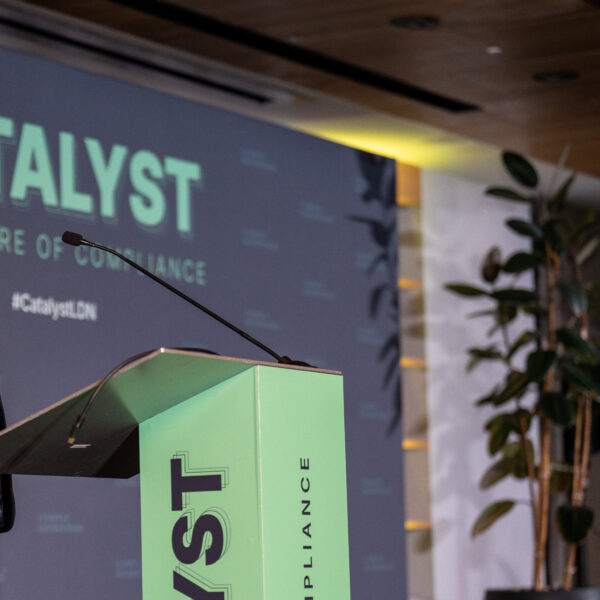
Speaking at CATALYST 2025, Lord Holmes outlined a roadmap for the future of financial integrity. By treating technology, legislation, and education as a single, holistic response, organizations can move from playing catch-up to building a proactive shield against global bad actors.
“If we human-lead, then we can succeed. We must put our values, our context, and our principles into these new technologies to solve issues that we couldn’t have addressed even five years ago.”
Lord Chris Holmes of Richmond
1. Closing the accountability gap in legislation
A primary hurdle in the modern landscape is an asymmetrical gap in liability. Most fraud today originates online, via social media, or through telecommunications such as text messages and phone calls. In authorized push payment (APP) scams, victims are manipulated into sending money themselves by sophisticated bad actors.
Historically, financial institutions (FIs) have borne the brunt of recovery costs, while the digital platforms where the fraud began face little to no financial penalty. Addressing this requires legislative evolution – such as the principles outlined in the Crime and Policing Bill – to ensure social media and telecom companies share liability for the content they host.
When digital platforms are held financially accountable for the criminal activity they facilitate, they are naturally incentivized to close the loopholes that scammers exploit.
2. Replacing antiquated verification with digital ID
A critical enabler of the current scamdemic is the failure of robust identity verification. Many digital systems still rely on antiquated 20th-century methods. This has led to absurd security gaps; for example, Lord Holmes noted that even “Daffy Duck” has been successfully registered as a director in the UK’s Companies House.
The Economic Crime Act 2023 was a significant step toward transforming these legacy systems, particularly in its empowerment of authorities to clean up fraudulent registrations. However, the industry standard for know your customer (KYC) checks remains flawed.
“The case for a permissioned, self-sovereign, and consented digital ID is incredibly powerful. We must stop relying on gas bills and utility letters as proof of identity. We have the technology to do better.”
Lord Chris Holmes of Richmond
The path forward requires a transition to:
- Permissioned systems: Secure, self-sovereign digital IDs where the user controls their own data.
- Public trust: Fostering discourse to build a public connection to the fight against ID fraud.
- Radical transparency: Replacing a patchwork of paper documents with an immutable digital trail that prevents criminals from hiding behind shell companies.
Catch up with all the keynote speeches, fireside chats, and panel discussions from Catalyst. Hear exclusive insights from our expert speaker lineup on-demand.

Watch all CATALYST sessions on-demand
3. Combining AI and DLT for a stronger tech alliance
To fight an enemy that is increasingly AI-literate, compliance teams must be equipped with superior digital weapons. Lord Holmes describes the ideal tech stack as a “constellation of technologies,” specifically combining artificial intelligence (AI) and distributed ledger technology (DLT).
- AI as the detective: Machine learning (ML) excels at analyzing massive datasets in real-time, spotting complex patterns of criminal behavior that a human eye would miss.
- DLT as the notary: DLT provides an immutable record of truth. Once data is verified and entered into the ledger, it cannot be altered or erased.
By combining pattern recognition (AI) with factual proof (DLT), organizations create a “shield” that is significantly harder for criminals to penetrate.
4. Strengthening the human firewall
Despite the power of these technologies, a purely technocratic approach is a mistake. A truly effective strategy must be “human-led,” ensuring that AI and ML systems are guided by human ethics, values, and contextual judgment.
Technology should enhance human decision-making, not replace it. Research suggests that roughly 82% of security breaches involve a human element – such as weak passwords or unsecure hardware.
“Think passwords, last words, and unlocked laptops. Because in 82% of these problems, there is a human involved who can become the weakest link. We must bolster our ‘human firewall’ through education and literacy.”
Lord Chris Holmes of Richmond
To support this human element, greater legislative reform is necessary. Lord Holmes advocates for the AI Regulation Bill, which proposes a “nimble, agile, and crucially horizontal” regulatory framework. Rather than a massive, slow-moving bureaucracy, this approach ensures that AI is governed across all sectors, closing the gaps that fraudsters currently exploit.
5. Adopting a holistic approach to success
The fight against organized FinCrime and cybercrime requires the overlap of legislation, education, and innovative technology. Success depends on cutting-edge regulatory technology (RegTech) to detect threats and legislation that holds all enablers of fraud accountable.
The tools to stop the scamdemic exist today. As Lord Holmes shared at CATALYST, the goal is to remain “rationally optimistic.” By keeping humans at the center of technological evolution, policymakers and business leaders can deploy these tools to create a safer and more transparent financial world. ComplyAdvantage Mesh provides 24/7 automated case remediation, freeing compliance teams from low-risk tasks and escalating only ambiguous cases, ensuring human expertise is focused on issues that require intuition and moral judgment.
Move toward a human + agentic compliance model
Originally published 22 December 2025, updated 27 February 2026
Disclaimer: This is for general information only. The information presented does not constitute legal advice. ComplyAdvantage accepts no responsibility for any information contained herein and disclaims and excludes any liability in respect of the contents or for action taken based on this information.
Copyright © 2026 IVXS UK Limited (trading as ComplyAdvantage).