

- Insights
- Featured Insights
As firms seek to modernize their tech stacks, agentic AI could become the key to unlocking budgets. In our annual compliance survey, 88% of firms saw higher approval rates when they included AI at the heart of their financial crime compliance modernization proposal. Understanding this capability as a business advantage – not merely an operational one – can help firms craft a clear case for its adoption.
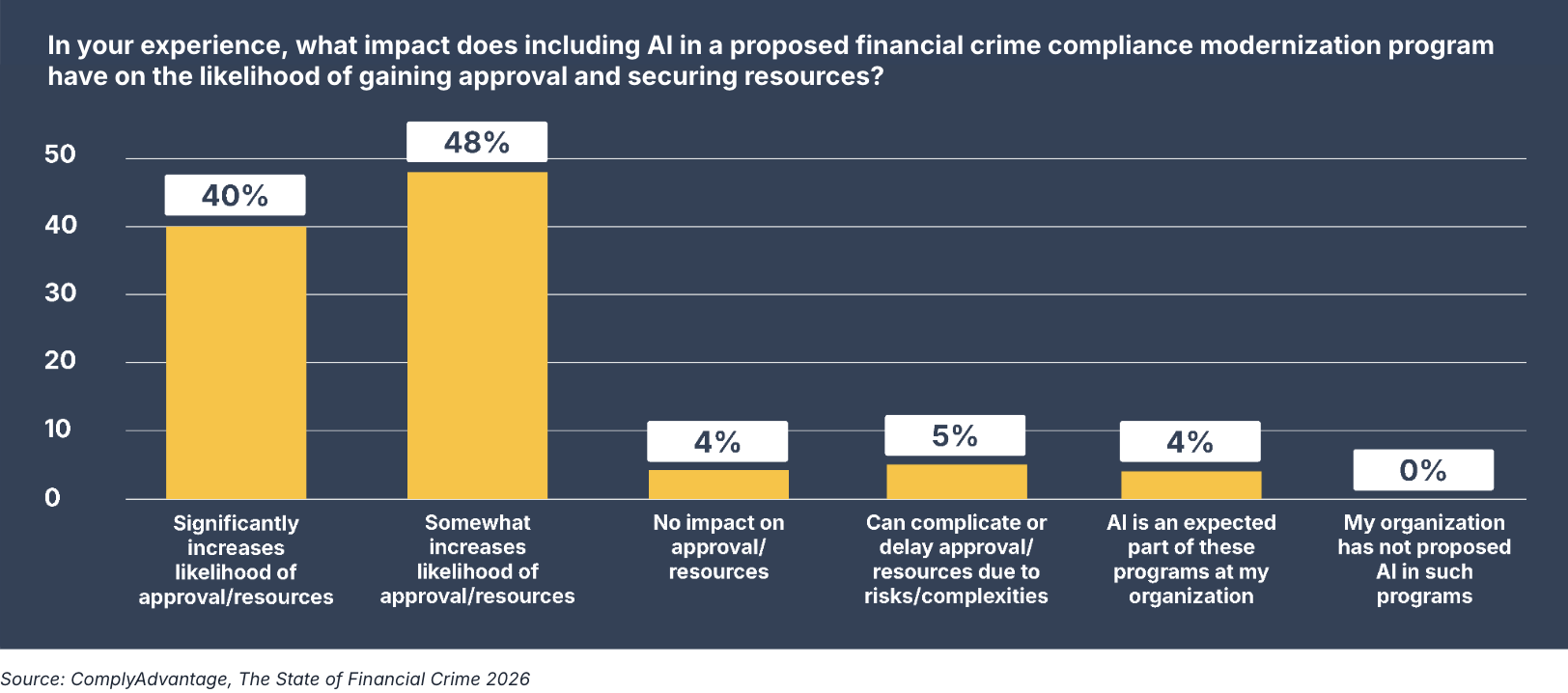
This article serves as a definitive guide for compliance leaders on how agentic and predictive AI can act as a catalyst for growth. We’ll explore the tangible return on investment (ROI) benefits of adopting this technology, using exclusive insights from our 2026 State of Financial Crime survey. Using these points, leaders can craft compelling cases for modernizing their compliance tech stack using this powerful development in artificial intelligence.
Glossary
Agentic AI describes AI models that are equipped with agency: the ability to plan, reason, and execute tasks in pursuit of objectives. Unlike ‘standard AI’ systems that are limited to a single output (eg. a model that flags a transaction as suspicious based on a pre-set rule), agentic AI can interact with external tools, adapt behavior based on context, and operate iteratively until the desired outcome is achieved. An example of agentic AI is the auto-remediation of level 1 alerts – where the AI not only identifies a low-risk alert but also independently gathers the necessary data, drafts the closure narrative, and closes the case without human intervention.
Predictive AI forecasts future outcomes by analyzing data patterns, while agentic AI acts autonomously to achieve goals by combining predictive capabilities with autonomous planning, decision-making, and action-taking in an environment, often involving multiple agents working together with human guidance or oversight. The key difference is prediction (what might happen) versus autonomous action (making it happen).
4 benefits compliance teams are realizing with agentic AI
Artificial intelligence (AI) has already streamlined many workflows, but agentic AI is unique. Where standard AI can intelligently interpret data to create more flexible, effective rules, agentic AI creates a literal team of AI agents that each specialize in specific tasks. These agents, when well-designed and trained on high-quality data and processes, can perform tasks in seconds that human teams could take hours or days.
The result is a workflow that’s greatly streamlined, much more effective, and supportive of human screening analysts who can now spend their freed time performing higher-value work. Investigations and reports can be completed to higher standards when teams aren’t rushed. This means greater operational efficiency, using fewer resources. It’s a win for everyone involved: firms, regulators, law enforcement, and the victims harmed by crimes adjacent to financial crime. And it also means that firms can scale compliance operations without a linear increase in headcount, so growth doesn’t have to mean increased regulatory gaps and penalties.
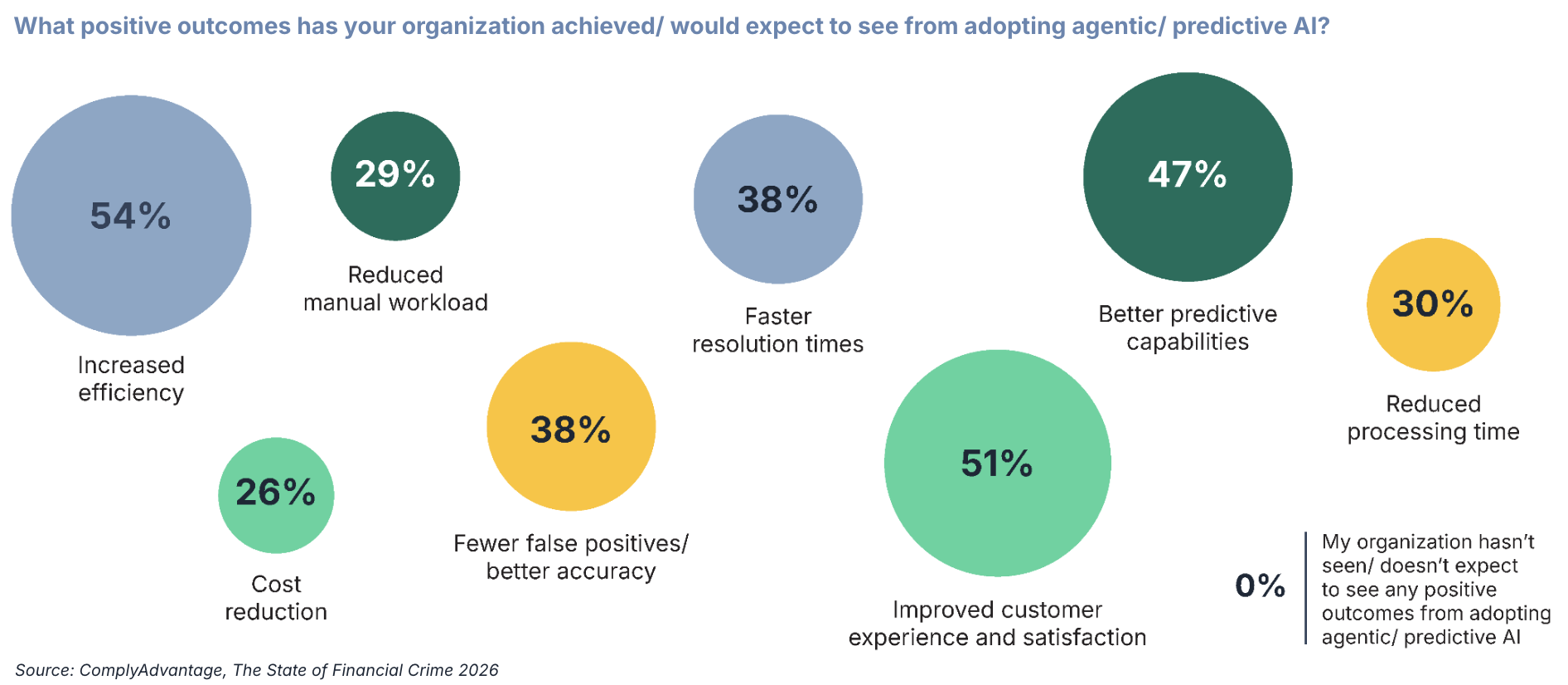
In our survey, respondents reported four relevant benefits they’d already seen or expected to see from implementing agentic or predictive AI.
1. Increased efficiency
54% of firms that responded to our survey associated agentic or predictive AI with better efficiency. For context, 41% had adopted at least one of these technologies for customer screening and onboarding, and 40% use at least one to streamline their case investigation. In practice, teams of AI agents can perform rigorous, step-by-step customer due diligence (CDD) investigations from start to finish: pulling and compiling key customer data for a human analyst that could have taken that one analyst hours to put together.
This efficiency is fundamentally tied to data freshness. AI agents are only as effective as the information they consume; if an agent relies on stale, third-party data with a 24-hour lag, its autonomous decisions are already outdated. By tethering agentic workflows to a direct-from-source pipeline – where, for example, sanctions update in under a minute – you eliminate this “execution gap.” This ensures agents act on real-time data, mitigating the need for manual rework and the risks caused by outdated information.
The alternatives to this scenario are expensive and inefficient: either hire the same number of human analysts to perform each of these checks, or leave the full manual workload to a smaller team and pay for time and accuracy instead.
2. Faster resolution times
38% of respondents said agentic or predictive AI meant alerts would be resolved faster. Again, this makes sense: each alert investigation requires manual steps traditionally taken by humans, which can take hours or days.
In contrast, agentic teams overseen by a human can simply perform the rote steps in such a workflow faster. By maintaining a human-in-the-loop architecture, firms can ensure these agents function as high-velocity digital colleagues that escalate complex cases to human experts, resulting in a resolution process that is both faster and more robust than traditional manual methods.
3. Better accuracy
Perhaps this is why 38% of respondents who use or are considering agentic and predictive AI also associate it with greater accuracy and fewer false positives. Streamlining doesn’t have to mean cutting corners: in fact, a truly scalable compliance solution should improve processes.
While predictive AI can improve initial alert precision, agentic AI enhances accuracy by fundamentally changing the nature of the human-in-the-loop experience. Instead of an analyst starting an investigation from scratch, an AI agent provides a pre-digested summary of risk, having already cross-referenced 100+ attributes through probability-based scoring. This eliminates the cognitive fatigue of manual data gathering, allowing analysts to focus on high-value investigations. When teams aren’t rushed to meet quotas on low-level alerts – of which up to 82% can be reduced through these algorithms – they make higher-quality decisions, leading to clearer reports and more defensible audit trails.
4. Improved customer experience and satisfaction
51% of respondents saw or expect to see better customer satisfaction from using agentic or predictive AI. And indeed, poor-quality or slow customer onboarding can be a major cost to businesses. Inefficient processes can mean legitimate customers are turned away or wait unreasonable times to be onboarded. This can lead to poor customer retention and even reputational harm amongst prospective customers when disgruntled applicants report their experiences.
Yet historically, teams have had their hands tied: compliant know your customer (KYC) processes must follow strict regulatory steps. Firms had to choose between inflating hiring costs or accepting onboarding lag, even risking turning away good customers. But with agentic AI, one analyst effectively has the power of dozens of counterparts without the time-consuming manual processes. This means CDD investigations can be more accurate and take less time, so customers can be onboarded as quickly and pain-free as possible.
From legacy automation to agentic AI
To be clear: each of the above scenarios translates into hard ROI improvements that support strong business cases. Agentic AI and AML compliance modernization may make life easier for anti-financial crime teams, but it also improves cost and revenue for financial institutions. When making the case to modernize their processes, compliance leaders can certainly emphasize that better compliance is a competitive advantage. It saves money, makes money, improves reputations, and can lead to better business partnerships.
Our survey highlighted the severity of the current execution gap: nearly 8 in 10 organizations (79%) still take more than five minutes to clear a single sanctions alert during the critical customer onboarding phase. In a world of instant digital expectations, these five-minute manual hurdles can compound into hours of delay. Moving beyond legacy automation to agentic AI transforms this process. By automating the rote remediation steps, firms can turn their compliance function into a high-velocity growth engine, not just a necessary financial burden to avoid regulatory fines.
Move toward a human + agentic compliance model
ComplyAdvantage Mesh provides 24/7 automated case remediation, freeing compliance teams from low-risk tasks and escalating only ambiguous cases, ensuring human expertise is focused on issues that require intuition and moral judgment.
Get a demoOriginally published 10 March 2026, updated 10 March 2026
Disclaimer: This is for general information only. The information presented does not constitute legal advice. ComplyAdvantage accepts no responsibility for any information contained herein and disclaims and excludes any liability in respect of the contents or for action taken based on this information.
Copyright © 2026 IVXS UK Limited (trading as ComplyAdvantage).