
- Insights
- Featured Insights
Wherever you do business, achieving anti-money laundering (AML) compliance means dealing with financial regulators and understanding legislation imposed at a national and international level. With so much legislative ground to cover, our guide to the world’s most important AML compliance regulations—and the organizations that enforce them—is a good place to start.
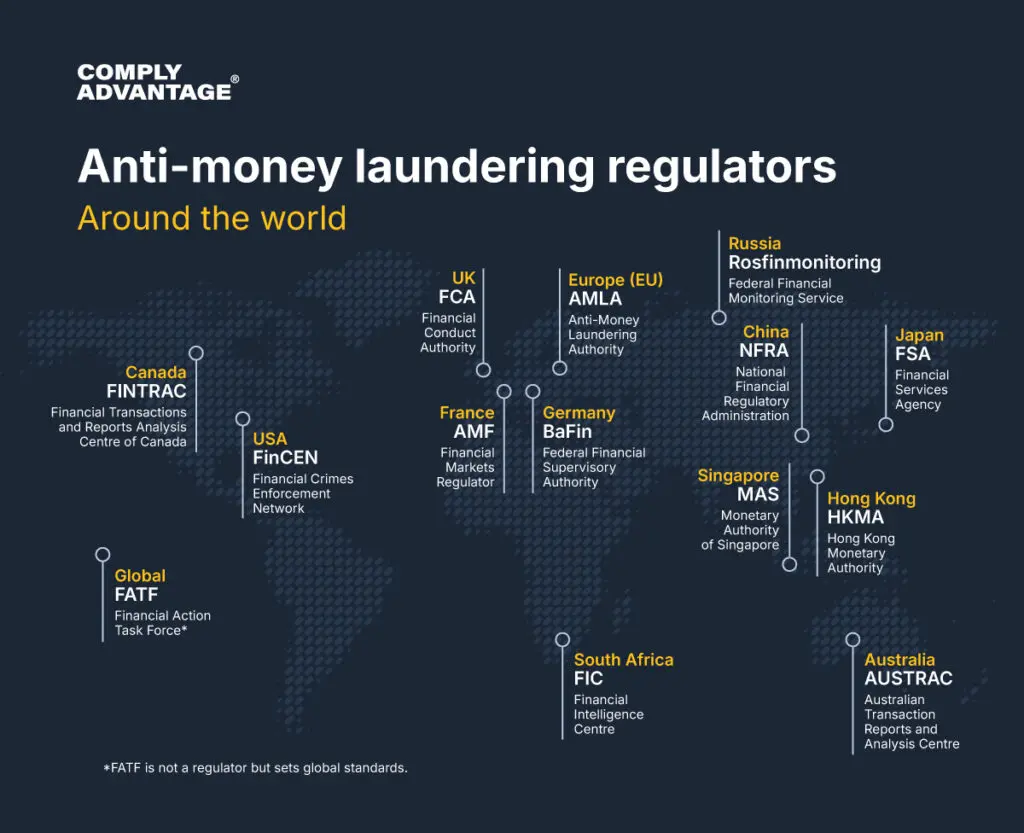
The global AML landscape is diverse, and financial institutions must keep pace with evolving rules and regulations to meet their compliance obligations.
Global Standards
The Financial Action Task Force (FATF)
The FATF is the premier intergovernmental organization dedicated to combating money laundering and the financing of terrorism. While not a direct regulator, it sets the Global Standards that national regulators then codify into law. Its jurisdiction spans the world, encompassing every major financial center. To comply with the framework adopted by member states, financial institutions should:
- Implement know-your-customer (KYC) and identity verification (IDV) measures.
- Perform FATF-recommended due diligence measures (CDD).
- Maintain suitable records of high-risk clients and transactions.
- Regularly monitor accounts for suspicious activity and report it to the appropriate national authority.
The European Union
EU 5AMLD and 6AMLD
The European Union uses Anti-Money Laundering Directives to harmonize AML/CFT legislation across its member states. To centralize oversight, the EU has also established the Authority for Anti-Money Laundering and Countering the Financing of Terrorism (AMLA), which ensures consistent supervision and can impose fines of up to 10% of annual turnover. The EU’s Fifth Anti-Money Laundering Directive (5AMLD) entered into effect in 2020 and the Sixth Anti-Money Laundering Directive (6AMLD) entered into effect in 2021. To comply with 5-6AMLD rules, financial institutions should be familiar with their contents:
- 5AMLD: Focuses on cryptocurrency regulation, legal definitions for crypto-wallets, and increased transparency regarding beneficial ownership and high-risk third countries.
- 6AMLD: Harmonizes the definition of “predicate offenses,” extends criminal liability to legal persons (companies), and introduces tougher punishments for non-compliance.
The UK
In the UK, the Financial Conduct Authority (FCA) is the primary regulator. It has shifted from checking “paper compliance” to testing the live effectiveness of systems, with 2025 seeing record fines totaling over £124 million. The FCA ensures firms adhere to three core pillars of legislation:
Proceeds of Crime Act 2002 (POCA)
The Proceeds of Crime Act 2002 is the bedrock of UK AML law. It defines the primary money laundering offenses, provides for the confiscation of assets, and creates the “failure to disclose” offense for those in the regulated sector who suspect money laundering.
Money Laundering, Terrorist Financing and Transfer of Funds (Information on the Payer) Regulations 2017 (MLRs)
The Money Laundering, Terrorist Financing and Transfer of Funds (Information on the Payer) Regulations 2017 set out the administrative requirements for businesses. This includes mandatory risk assessments, the appointment of a Money Laundering Reporting Officer (MLRO), and the implementation of robust KYC and due diligence procedures.
The Terrorism Act 2000
The Terrorism Act 2000 focuses specifically on the movement of funds for terrorist purposes. It mandates that firms report any suspicion that a person is providing, using, or possessing money for the purposes of terrorism.
North America
The Bank Secrecy Act (BSA), United States
Administered by the Financial Crimes Enforcement Network (FinCEN), the Bank Secrecy Act is the foundation of the US AML framework. It requires financial institutions to maintain a formal compliance program, including written policies, employee training, and an independent audit schedule.
The USA PATRIOT Act, United States
Enacted after 9/11, the USA PATRIOT Act significantly amended the BSA to strengthen the government’s ability to prevent, detect, and prosecute international money laundering and the financing of terrorism. It introduced stricter “know-your-customer” requirements for foreign correspondent banking.
The Anti-Money Laundering Act of 2020 (AMLA), United States
The most significant update since the PATRIOT Act, the Anti-Money Laundering Act of 2020, modernized the regime by establishing a beneficial ownership registry and strengthening whistleblower protections and rewards to encourage reporting of corporate misconduct.
The Proceeds of Crime (Money Laundering) and Terrorist Financing Act PCMLTFA, Canada
In Canada, the Proceeds of Crime (Money Laundering) and Terrorist Financing Act is the primary law, overseen by the regulator Financial Transactions and Reports Analysis Centre of Canada (FINTRAC). Recent 2025/2026 updates expanded its scope to include factoring companies and cheque-cashing businesses, backed by a more aggressive enforcement posture.
Asia-Pacific
The Anti-Money Laundering and Counter-Terrorist Financing Ordinance (AMLO), Hong Kong
Regulated by the Hong Kong Monetary Authority (HKMA), the Anti-Money Laundering and Counter-Terrorist Financing Ordinance provides the legal requirements for customer due diligence and record-keeping for financial institutions in Hong Kong. It empowers regulators to order penalties of up to HK$10 million for non-compliance.
The Corruption, Drug Trafficking, and Other Serious Crimes Act 1992 (CDSA), Singapore
The Monetary Authority of Singapore (MAS) enforces the Corruption, Drug Trafficking, and Other Serious Crimes Act 1992, which is the primary legislation for the confiscation of criminal proceeds. It works alongside MAS Notices to ensure institutions perform rigorous KYC and monitoring.
The Anti-Money Laundering Act of 2001 (AMLA), Philippines
Enforced by the Anti-Money Laundering Council (AMLC), the Anti-Money Laundering Act of 2001 covers a broad range of “covered institutions,” including offshore gaming operators. 2026 updates have granted the AMLC further powers to issue administrative freeze orders and oversee virtual asset service providers (VASPs).
AML/CTF Act (2006), Australia
Australian Transaction Reports and Analysis Center (AUSTRAC) is the Australian government’s primary financial intelligence agency. It operates under the AML/CTF Act to monitor the financial system. Entities must detail transactions over certain thresholds (TTRs) and submit suspicious matter reports (SMRs) to remain compliant.
Remaining compliant and navigating these rigorous standards requires a sophisticated, scalable approach, particularly for global entities like Nissan Financial Services. Operating across 12 markets, including the US and Australia, Nissan utilized ComplyAdvantage to transform their compliance hurdles into operational efficiencies:
“ComplyAdvantage has been fantastic for us. Implementation has been seamless and straightforward, and the cost savings that we’ve made over the past three years have been significant. As regulations have increased, we’ve managed to actually decrease the cost of our financial crime compliance program.”
John Skorup, Global Head of Compliance – Sales Finance at Nissan Financial Services
Streamlining compliance with modern AML solutions
As global regulations in the UK, EU, Asia, and the US continue to tighten, manual compliance processes are no longer sufficient to mitigate risk or meet regulations. To keep pace with these legislative demands, financial institutions (FIs) must leverage agile, real-time technology. By integrating a risk-based approach into your onboarding and monitoring workflows, you can ensure your institution remains compliant with national laws while reducing false positives and focusing resources on the threats that matter most.
ComplyAdvantage AML solutions
Streamline the whole KYC AML process with help from our automated onboarding and monitoring tools.
Automate client onboardingOriginally published 05 June 2019, updated 30 March 2026
Disclaimer: This is for general information only. The information presented does not constitute legal advice. ComplyAdvantage accepts no responsibility for any information contained herein and disclaims and excludes any liability in respect of the contents or for action taken based on this information.
Copyright © 2026 IVXS UK Limited (trading as ComplyAdvantage).