

- Insights
- Featured Insights
As illicit actors weaponize artificial intelligence to scale their operations, a new sense of urgency is defining the global compliance landscape. The critical question is no longer if defenses need to evolve, but how quickly they can be deployed.
To explore this challenge, we gathered a select group of Singapore’s industry leaders for AML Unplugged, an exclusive fireside chat hosted by our Executive Director of FCC Strategy, Iain Armstrong. The event gave attendees an exclusive preview of the Asia-Pacific findings from our sixth annual State of Financial Crime 2026 report and provided a forum to debate its most critical findings.
The discussion, featuring insights from Yi Liang Lee (RazorPay Singapore), Angela Ang (TRM Labs), and Julia Chin (JFourth Solutions), moved from the foundational problems of data to the dual threat and opportunity posed by AI.
Here are three key takeaways from that conversation.
1. Why is data fragmentation an enduring compliance challenge?
For many financial institutions (FIs), the biggest challenge isn’t adopting new technology, but grappling with the old. The panel agreed that data fragmentation remains a primary operational hurdle, preventing a truly unified view of risk. Instead of attempting a costly full consolidation, the focus is shifting to making systems work together.
“Firms are thinking about how to at least make [their systems] talk to each other. That seems to be the notion of where organizations are leading… How do I make the systems co-exist rather than trying to make everything one as a whole?”
The discussion highlighted two core drivers behind this challenge:
- Legacy systems: Customer data from the 1960s and 70s is often poorly digitized or contains errors from manual transposition, creating a weak foundation for modern compliance systems.
- The M&A effect: Mergers and acquisitions often result in newly acquired customer bases sitting on separate, siloed systems. Full data integration is rarely achieved due to the high cost and complexity.
2. How can firms separate AI hype from reality?
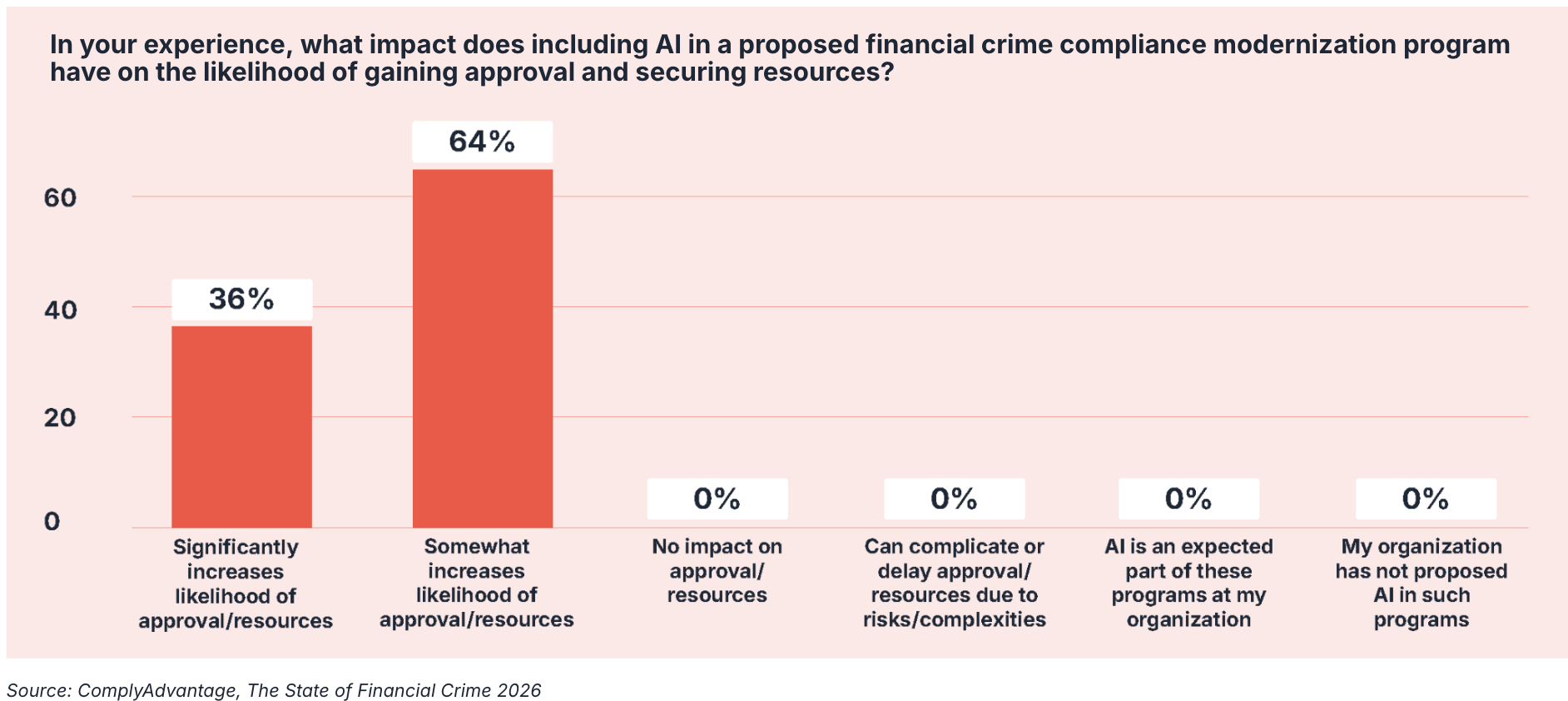
The rush to adopt AI is palpable. Our 2026 report reveals the industry’s response to this trend: 100% of our survey respondents in Singapore said an AI project was more likely to get budget approval. This powerful enthusiasm is fueled by factors like the Singaporean government’s plan to invest $1 billion in the industry over the next five years, creating a top-down push that filters through to every level of the market.
However, the panel cautioned that the real value of AI is not in the hype, but in its ability to solve practical problems that are beyond human scale. Even with a perfectly unified interface, a single person cannot reasonably process decades of complex data. This is where AI transitions from a buzzword to a critical business tool.
“If I tell you to address 50 years’ worth of data and then give me some insights, a human wouldn’t be able to do it. That’s how you leverage AI. It can take everything into context and give you something that has been fed into the system for 50 years. With that as an assistant, you are able to consume 100% of the data.”
The key takeaway is that while the excitement is warranted, the focus must be on practical application. True progress requires rigorous due diligence and a clear vision for how AI will augment human capabilities, especially as regulators demand full accountability and explainability for all AI-driven decisions.
3. Redefining the future workforce: From automation to augmentation
While the threat of AI-powered criminals is real, the panel suggested that the most critical challenge is internal: how to strategically evolve the compliance workforce. A key theme was the erosion of traditional “over-the-shoulder” learning in a remote-first world. The panel argued that the biggest mistake firms can make in response to AI is simply to cut entry-level jobs.
Instead, the forward-thinking approach is to transform these roles entirely. The discussion highlighted a new purpose for junior employees: not as processors of manual tasks, but as essential human-in-the-loop operators who interact with, train, and learn from the AI.
“Firms mistakenly think they can cut huge numbers of entry-level staff because of AI. The goal should be keeping people in those jobs, but changing the job. The job should be about interacting more with the AI.”
This strategy creates a powerful feedback loop where human curiosity and creativity continuously improve the technology, while the technology augments the team’s capacity. In this model, the essential human skills discussed by the panel – compassion, curiosity, creativity, and communities – are not just a defense against automation, but the very engine of a more effective, AI-augmented compliance function.
Interested in the full data set that drove our discussion?
Read our annual report to explore the most important trends affecting the financial crime landscape and find out how you can prepare for the year ahead.
Download nowOriginally published 17 April 2026, updated 24 April 2026
Disclaimer: This is for general information only. The information presented does not constitute legal advice. ComplyAdvantage accepts no responsibility for any information contained herein and disclaims and excludes any liability in respect of the contents or for action taken based on this information.
Copyright © 2026 IVXS UK Limited (trading as ComplyAdvantage).