
Notes from Geneva: What I heard at AI for Good 2026
Written by Joana Santos
Written by Joana Santos
By Joana Santos, Director of Data Science, ComplyAdvantage
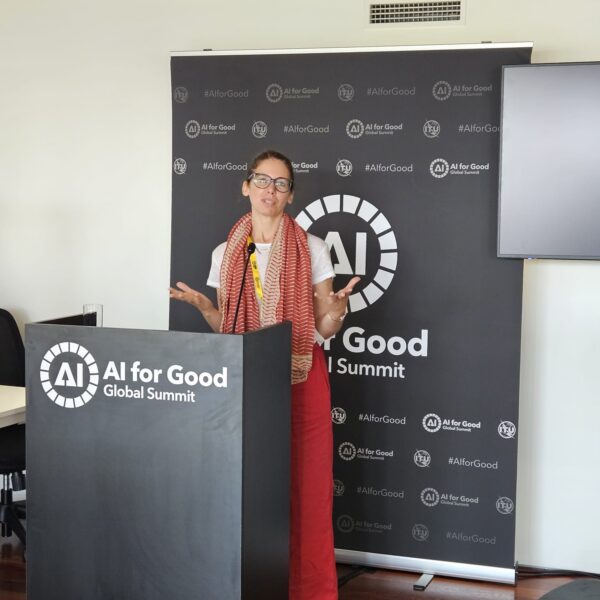
I spent the second week of July in Geneva at the AI for Good Global Summit, the United Nations (UN) platform on artificial intelligence (AI), organized by the International Telecommunication Union (ITU) alongside over fifty UN agencies. With 12,000 participants from more than 170 countries, serving as a Steering Committee member and speaker gave me a rare perspective across research, policy, and industry–all under one roof.
My own path into this work hasn’t been traditional. I started in astrophysics research, moved into enterprise AI and LLM deployments at Microsoft, and now lead data science at ComplyAdvantage, where we build AI for financial crime compliance. It is a space that gives you zero room to be casual about how a model reaches its conclusions.
I left Geneva even more convinced of something I’ve felt for a while: the most difficult problems in AI today are problems of trust, sovereignty, and governance. Technical capability has, for the moment, run ahead of our ability to place it responsibly. Three conversations from that week are worth setting down.
The masterclass I ran at the Innovation Factory, “Scaling AI with Integrity: From Prototype to Trusted Product,” was scheduled right after lunch on a very hot afternoon in a room without air conditioning. Fighting off a post-lunch slump in that heat was a real test, yet the group of selected startup accelerator founders who joined were completely engaged. Almost every one of them had built something that worked, but wasn’t sure how to turn it into a reliable, production-ready product.
The pattern I described at the start was one everyone in the room recognized immediately: a proof of concept works on a small dataset, the team gets excited, and then the project stalls somewhere between the demonstration and production, often for a year or more.
When I look at why prototypes stall, the reasons tend to fall into three groups. There are strategy failures, where there is no architecture for scale behind the proof of concept, priorities are misaligned across teams, and someone expects a finished product on minimal investment. There are execution failures, where no phased delivery plan exists, and no business or performance metrics were agreed before the work began. And there are human failures, where users are excluded from the process, no feedback loop exists, and nobody has been made responsible for taking the model into production and keeping it there.
The third group is where I see most failures begin. In my experience, models fail in production less often because the science was poor than because ownership was never established. Explainability, data governance, monitoring for drift, and clear accountability are all far cheaper to build into the first version than to retrofit once customers depend on the product.
I offered the room four things a small team can put in place inside a week. Name a model owner so that accountability rests somewhere specific. Write a one-page model card before go-live, covering what the model does, the data on which it was trained, and its known edge cases. Set one metric to monitor, so that you will notice when performance degrades. And adopt two or three responsible AI principles, such as fairness, transparency, and explainability, and hold yourself to them.
While these might sound like fundamental steps, they address the single biggest blind spot in early-stage AI. When I asked the room who specifically owned each model, there was a quiet pause – and the answers that came back pointed broadly to ‘the company.’ These were serious, talented founders with working products and paying customers, yet named individual ownership hadn’t been established. That gap is natural at the startup stage, but it illustrates the real divide between a prototype and a product. It rarely comes down to the quality of the science; it comes down to ownership.
Yoshua Bengio made a related argument from a different direction, and was among the more sober voices of the week. His non-profit, LawZero, is building what he calls a Scientist AI: a non-agentic system that returns probabilities rather than confident answers, on the principle that a model aware of the limits of its own knowledge is safer than one that isn’t. Humility, on that account, becomes an engineering property rather than a matter of temperament, which means you can specify it and test it.
The Innovation Factory closed with an awards ceremony, where one of the judges, will.i.am, decided on the spot that all three finalists should receive the full prize money – meaning the overall winner actually walked away with a double award. I had to be told afterward who he was, which I gather makes me unusual, given the queue that formed for photographs! But for three teams who spent months pouring everything into their prototypes, that extra funding will go a long way.
The AI Skills Coalition roundtable and the Coalition’s annual partner meeting both pointed in the same direction. Global AI readiness depends far more on people, skills, and governance structures than on any particular technical breakthrough. Models don’t govern themselves, and the people who govern them need training, cross-disciplinary judgment, and governance structures clear enough to guide a decision.
This is the thinking behind the AIC Framework, an initiative led by my fellow Steering Committee member Em Lenartowicz, which I’ve been supporting through the working group. The framework is concerned with embedding agency, intent, and accountability into AI design, so that human oversight survives as models become more autonomous.
I also took part in an invitation-only dialogue hosted by the Network of Women Leaders in ICT at the ITU Leadership Lab, alongside government ministers and industry leaders, on gender-responsive AI governance. Women remain underrepresented both in the technical teams that build these systems and in the rooms where they are governed. My working assumption has always been that this shapes the technology itself, because when the people designing and overseeing a model don’t resemble the range of people it affects, the blind spots find their way into the architecture.
At a dinner on Monday evening focused on sovereignty and collaboration, the conversation kept returning to a central tension: countries increasingly want control over their own AI capabilities and data, yet the global challenges AI is meant to address respect no borders.
This resembles a choice I’ve worked through inside my own teams, which is whether to govern AI through federated or centralized control. I’ve generally found federated control works better. It keeps the teams closest to the work accountable for the risks they create, and it stays aligned to what the business is actually trying to do. Heavy centralization tends to produce remote tick-box exercises that slow everything down without improving oversight in any way I’ve been able to detect.
It does have a failure mode. A team accountable for its own risk will occasionally decide in complete good faith that a risk is acceptable when it isn’t, and a federated model gives you no reliable way to catch that from the inside. Some central function has to exist as a check, even if it holds far less authority than a centralized regime would grant it.
The same argument runs between countries, though the dinner had a subject nobody chose to name directly. Frontier capability, along with the compute and the capital behind it, sits in a very small number of states, at least one of which has been entirely explicit about the scale of its ambitions. Delegates from countries without that capacity were candid about their position, which is a choice between depending on infrastructure they don’t control and having no capability at all.
Advising them to preserve local ownership is easy counsel to offer from a country that has the option. Federated approaches, in which institutions and countries collaborate without surrendering control of their data, still seem to me the more promising direction, and for many states, shared institutions may be the only realistic route to anything at all. They are also difficult to build, which is an argument for attending to them now rather than during the next crisis.
None of this is abstract in our industry.
Three things have shifted more or less at once. Regulation has caught up with what AI can do. Buyers now ask hard explainability questions well before they sign anything. And agentic AI, which acts rather than only flags, has raised the governance bar again. In financial crime compliance, governance has started to decide deals, because a model whose decisions cannot be explained cannot be sold into a regulated function at all.
Ownership and explainability stop being optional the moment a model informs a decision that a regulator, an auditor, or a court may later examine. Whether a compliance team has the skills and the governance structures around it determines whether they adopt AI with confidence or end up dependent on a system they never fully understood. And the pull between sovereignty and collaboration describes the daily problem of pursuing cross-border crime under fragmented national rules.
Our work at ComplyAdvantage sits across all three. We build AI to analyze risk, prioritize the alerts that deserve attention, and give compliance teams their time back for the cases that are genuinely difficult. Doing that credibly means holding ourselves to the standard I was asking those founders in Geneva to adopt: performance we can prove, decisions we can explain, and someone whose name is against every model we run.
I returned home far more optimistic about the future than I’d expected to be at the start of the week. The questions the world is now asking about AI are largely the questions our industry has confronted for years, and after a week among people asking them for the first time, I think we understand rather more than we realize.
Originally published 31 July 2026, updated 31 July 2026
Disclaimer: This is for general information only. The information presented does not constitute legal advice. ComplyAdvantage accepts no responsibility for any information contained herein and disclaims and excludes any liability in respect of the contents or for action taken based on this information.
Copyright © 2026 IVXS UK Limited (trading as ComplyAdvantage).