
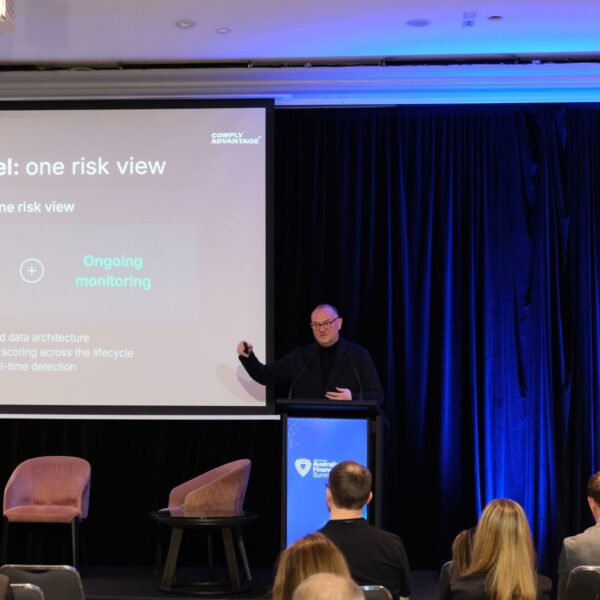
One customer, one risk view: Connecting onboarding and monitoring to detect fraud in real time
Written by Andrew Davies
Written by Andrew Davies
Effectiveness is the word regulators keep returning to. At the Australian Financial Crime Summit (AFCS) in Sydney on September 1, 2026, Andrew Davies – Global Head of Financial Crime Compliance (FCC) Strategy at ComplyAdvantage – set out why no compliance team can evidence effectiveness while onboarding and ongoing monitoring sit in separate systems.
The Australian numbers show what that gap costs. The National Anti-Scam Centre reported $2.18 billion in scam losses for 2025, driven by 274,577 loss-bearing reports. Concurrently, the Australian Transaction Reports and Analysis Center (AUSTRAC)’s Money Laundering Update 2026 highlights increasingly sophisticated techniques like AI-enabled document fraud. This rising tide coincides with a major regulatory shift: Tranche 2 AML/CTF obligations took effect on July 1, 2026, bringing roughly 80,000 new businesses into scope.
Furthermore, banking, telecom, and digital platforms must now join the Australian Financial Complaints Authority (AFCA) ahead of the Scams Prevention Framework’s strict detection obligations, which take effect on March 31, 2027. Meeting these obligations requires firms to see their customers as a whole.
“I’ve worked with so many organizations around the world – global organizations, organizations here in Australia – that deal with many siloed solutions and aren’t able to connect the dots. How can you be effective in implementing a risk-based approach if you’ve got siloed systems?”
– Andrew Davies, Global Head of FCC Strategy at ComplyAdvantage
Bringing risk mitigation and commercial growth into the same conversation is a vital business imperative. Protecting the customer relationship and its lifetime value reinforces the overall business model, as customers inherently expect safety and security before anything else.
“So by having effective financial crime controls, and in a fraud instance by having effective fraud mitigation, you’re actually reinforcing that relationship and that lifetime earnings that you get from your customers. People expect that your financial services products are safe and secure, and it engenders trust in not only your organization but also in the financial system.”
– Andrew Davies, Global Head of FCC Strategy at ComplyAdvantage
The compliance industry arrived at its current structure in sequential stages – from sanctions screening and money laundering to transaction monitoring – ultimately leading to “FRAML” (running fraud and AML under a single discipline). However, treating fraud and AML as the only two poles of financial crime is no longer sufficient.
“The reason why we need to be beyond FRAML is because unusual activity could be indicative of human trafficking.”
– Andrew Davies, Global Head of FCC Strategy at ComplyAdvantage
Unusual activity is rarely confined to a single crime type. The International Labour Organization (ILO) estimates 50 million people are living in modern slavery globally, and their proceeds move through standard payment networks. Consequently, bodies such as AUSTRAC, the Financial Crimes Enforcement Network (FinCEN), the Monetary Authority of Singapore (MAS), and the Financial Action Task Force (FATF) have expanded their definitions of financial crime to include proliferation financing, bribery, and corruption.
Because transnational crime accounts for $1.6 trillion to $2.2 trillion annually according to Global Financial Integrity research, detection must become a network exercise. Complex networks – like the global fentanyl supply chain moving from China through Mexico to the US – operate as sophisticated, cross-border supply chains.
“Financial crime is a network problem. […] So we have to solve this network problem with networks ourselves.”
– Andrew Davies, Global Head of FCC Strategy at ComplyAdvantage
The operational gap opens right at the handoff. Most firms treat onboarding as a completed step: they calculate a risk score and verify identity, but fail to pass this critical context to their ongoing monitoring systems.
“If you onboard a customer, you do a risk score, you make sure you’ve done the appropriate initial due diligence, you’ve validated their identity. If you’re not using that information in the ongoing monitoring of their behavior, then you’re missing a trick. You’re not taking advantage of all of that interconnectedness of the network. “
– Andrew Davies, Global Head of FCC Strategy at ComplyAdvantage
This fragmentation is heavily documented. Our State of Financial Crime 2026 research reveals that over half of compliance leaders work across eight to ten separate systems, even though 99% agree an integrated interface is essential. Every siloed system is a vulnerability where customer risk profiles fall out of date.
“That introduces all sorts of concerns and questions about how you manage the veracity, the continuity, the integrity of your data, given that you’ve got these disparate systems. It’s impossible. So you need to bring everything together. You need an overlay to draw all of the information together so we can appropriately mitigate risk.”
– Andrew Davies, Global Head of FCC Strategy at ComplyAdvantage
This does not require a complete legacy overhaul. An orchestration layer can serve as an overlay, unifying customer identity and risk signals across existing underlying systems.
Once a unified view of the customer is established, compliance teams can measure and prove effectiveness across three key business dimensions:
“The one thing I want to feed into my measurement of effectiveness is a single view of the customer […] What’s my exposure? What’s my quantifiable risk that I can talk to my executives and my regulators about? How am I operationally remediating and dealing with those issues across transaction monitoring and screening and onboarding? And then what does that mean for my business?”
– Andrew Davies, Global Head of FCC Strategy at ComplyAdvantage
By ensuring investigation outcomes feed directly back into screening and monitoring, the next cycle begins with the lessons of the last. A single view of the customer is a powerful operating model, and the vanguard of financial crime compliance is designed to protect both the business and the public.
“You’re the vanguard, you’re the point of the spear in financial crime. […] Those vulnerable adults, those vulnerable portions of the population – they should be protected by the data, and the technology, and your expertise.”
– Andrew Davies, Global Head of FCC Strategy at ComplyAdvantage
Originally published 16 September 2026, updated 17 September 2026
Disclaimer: This is for general information only. The information presented does not constitute legal advice. ComplyAdvantage accepts no responsibility for any information contained herein and disclaims and excludes any liability in respect of the contents or for action taken based on this information.
Copyright © 2026 IVXS UK Limited (trading as ComplyAdvantage).