
CSSF 26/906: One sentence to rule them all
Written by Iain Armstrong
Written by Iain Armstrong
Fifty pages of new rules, and the single sentence that should make Luxembourg’s FinTechs sit up and take notice
I recently spoke at Nexus Luxembourg, in a session on the EU Single Rulebook and, more narrowly, on what CSSF Circular 26/906 means for the country’s PayTechs and FinTechs. During a fireside chat with Anida Mumdzic of Schiltz & Schiltz, I found myself making a point I had not planned to make. It lodged in my mind, and throughout the rest of the event, I tested it on the compliance people I met on the floor. Nobody disagreed.
What I said was this: the most consequential thing in this fifty-page circular is the requirement to write down a single sentence once a year.
On its face, that’s a strange claim, so let me defend it.
The sentence lives at paragraph 71: once a year, every member of the management body must sign a written statement confirming full compliance with the circular. One sentence, signed off individually by the leadership, and submitted to the CSSF by the end of March following the financial year end (which, for most firms, means the first real test arrives in Q1 next year).
There’s obviously plenty more across the circular’s fifty pages that matters: the detailed requirements for governance, for risk management, for the compliance function. But these things comprise what a robust compliance program has always looked like.
The sentence does something new: for starters, what does it take to sign the thing honestly? To put your name to that statement with any confidence, you need to know:
None of that is particularly out of the ordinary. But this paragraph takes a duty that used to belong to the institution – a diffuse, shared, faintly ownerless thing – and pins it to named individuals. A signature removes what’s sometimes called an ‘accountability sink’. It says, “we, personally, are telling the regulator that the firm complies.”
And alongside the attestation, the Chief Compliance Officer (CCO) must produce an annual report: the monitoring program, the main findings, and an overall opinion on whether the preventive framework is adequate, which goes to the CSSF and the statutory auditor.
So we have a claim made to a regulator, by named individuals, backed by a document they will read closely. That changes the character of the exercise, and it underscores something my CEO, Vatsa Naramasimha, said at our Catalyst event last year: that FinCrime compliance is now a ‘board-level problem’.
Not all firms are subject to the circular, but the barrier for consideration is relatively low, as it applies to firms that say ‘yes’ to any of the following:
Luxembourg has a thriving start-up scene, and I met plenty of young businesses at Nexus that met one or more of the above criteria.
Why is that relevant? Compliance infrastructure in a fast-growing FinTech tends to grow organically (not to mention unevenly) rather than be thoughtfully designed-in from the start. This fact was borne out in our 2026 State of Financial Crime report, which found that survey respondents reported it’s not atypical for a firm to be juggling as many as 9 systems to manage financial crime risk.
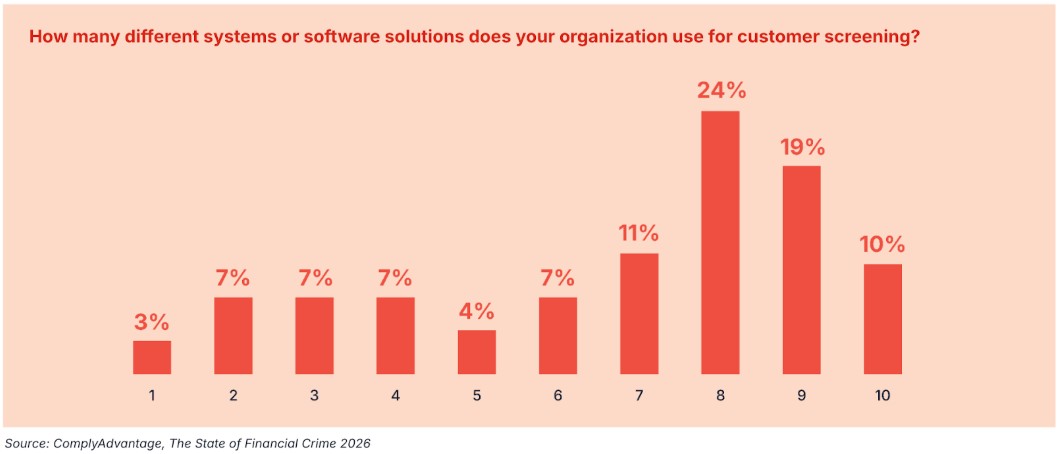
The result, for a great many firms, is a stack that cannot, on demand, tell a single coherent story. To stand behind the attestation and the CCO’s report, you have to show – from one joined-up record – how an alert was generated, who looked at it, what they decided, and why. Assemble that by hand across three disconnected systems, and you have something fragile, slow, and precisely the kind of weakness an inspection is built to expose.
The circular comes into force on 30 June. The first attestation is due in Q1 2027. For some, that nine-month window is the period in which the compliance function will need to build the governance infrastructure to support a statement that the management body can sign honestly.
There are three things I’d do if I were working in an impacted firm:
It will take a matter of seconds for the management body to sign off in early 2027. Getting to a point where it can be signed with confidence may take much longer.
Case management and the audit trail: The attestation and the CCO’s annual report both require a traceable record covering the full alert lifecycle – from detection through to disposition. ComplyAdvantage’s case management module stores that record in a single platform, eliminating the need for manual aggregation across disconnected systems.
Name screening: The circular’s risk-based approach requires screening controls calibrated to current risk, not configured once and left. ComplyAdvantage builds and maintains its own screening database, using machine learning for continuous entity resolution – producing a cleaner matching surface, fewer false positives, and controls that can demonstrate proportionate calibration to a CSSF inspector.
Transaction monitoring: The obligation to maintain risk-based monitoring that reflects an evolving risk profile applies directly to transaction monitoring rule sets. ComplyAdvantage’s Transaction Monitoring risk application supports scenario review and threshold adjustment as an institution’s product mix or customer risk profile changes.
The AI remediation agent: Paragraph 68 of the circular requires the compliance function’s input before decisions that could materially affect the institution’s risk profile. Deploying an AI agent to recommend alert closures is arguably a decision of this kind. Our L1 agentic remediation is designed with this in mind: the agent recommends closure only when the case is clear, documents a rationale for every recommendation, and keeps a human reviewer in the loop. The audit trail produced is a strong governance record as much as an operational one.
CSSF 26/906 raises the bar on evidence, governance, and audit trails. ComplyAdvantage Mesh unifies screening, monitoring, and remediation in one AI-native platform, so the proof a regulator asks for is already in one place. See what that looks like for your firm.
Get a demoOriginally published 06 July 2026, updated 06 July 2026
Disclaimer: This is for general information only. The information presented does not constitute legal advice. ComplyAdvantage accepts no responsibility for any information contained herein and disclaims and excludes any liability in respect of the contents or for action taken based on this information.
Copyright © 2026 IVXS UK Limited (trading as ComplyAdvantage).