
- Insights
- Featured Insights
Singapore’s largest money-laundering case to date put a hard number on the cost of programs that react too slowly. After roughly S$3 billion in assets were seized in 2023, the Monetary Authority of Singapore (MAS) fined nine financial institutions a total of S$27.45 million in July 2025.
What deserves even more attention is what happened next: in eight of those nine firms, systems had flagged the suspicious activity – the alerts fired, but the response lagged. Meanwhile, victims lost at least $10 billion to Southeast Asia-based scam operations in 2024, up 66% year on year. In truth, most programs were built for yesterday’s risks and have not kept pace with threats. When money settles in seconds, and attack methods sharpen in days, static programs fall behind.
At the second session of our Future of Compliance Asia-Pacific summit in Singapore, Andrew Davies, our Global Head of FCC Strategy at ComplyAdvantage, was joined by:
- Samson Leo, Chief Legal Officer at StraitsX
- Ivan Zasarsky, Senior Managing Director at PwC South East Asia Consulting
- Derrick Ong, Director of Financial Crime Strategy and Transformation at Trust Bank Singapore
Together, they walked us through the significance of dynamic, real-time compliance in a fast-evolving threat landscape.
The threat landscape has gone real-time
One notable threat across the region is social engineering, where victims are coerced into authorizing payments themselves, in fiat or crypto.
“Specifically, the type of mechanisms that we are seeing is social engineering, where authorized payment transactions go through because the victim is willingly convinced that they have to make this payment to some other payment address, whether by way of fiat or by way of crypto.”
– Samson Leo, Chief Legal Officer, StraitsX
Every authorized scam relies on a receiving account ready to absorb the stolen funds. Today, laundering patterns move away from individual money mule profiles toward complex corporate structures and shell companies. Beneath this lies a growing systemic threat: digital wallets holding unverified tokenized real-world assets that can be traded instantly, reminiscent of the high-risk securitization that triggered the 2008 financial crisis. As tactics evolve, yesterday’s ransomware threats have mutated into today’s account takeovers and internal mule networks.
Static rules operate in a rear-view mirror
Rules lag because they are built on stale data. When scam victims were being told to buy gold bars from merchants, one retail bank needed roughly a week to implement new rules. By then, detection had plummeted, and genuine gold buyers were being blocked because the typology had moved on.
“Scam typologies, authorized push payment (APP) typologies, or mule typologies change in the blink of an eye – they change faster than we can change rules.”
– Derrick Ong, Director, Financial Crime Strategy and Transformation, Trust Bank Singapore
The problem predates the current wave. Anti-money laundering (AML) programs built 25 years ago on rules and structured query language (SQL) struggled then and do not work now, because detection built around known typologies is always looking backward.
“By the time a typology is understood, it can’t be defended. This is operating in a rear-view mirror continuously.”
– Ivan Zasarsky, Senior Managing Director, PwC South East Asia Consulting
The alternative is signal-based processing that reads behavioral patterns in real time, backed by iterative models with a feedback loop layered on top of rules rather than replacing them.
From reporting to prevention
A program built around post-transaction monitoring made sense when the concern was money laundering. Scams broke that model, because a suspicious transaction report (STR) filed after the money has gone does nothing for the victim, so the measure of success changed.
“Effective to me is how do we prevent the crime, not how do I file an STR. How do I make sure the scammer doesn’t make away with the money, and the victim doesn’t lose money? To me, that is successful.”
– Samson Leo, Chief Legal Officer, StraitsX
Where a firm draws the line depends on where it operates. In a high-trust market, it can justify asking one more question, or holding a payment, before a customer sends S$250,000 to someone met on a messaging app.
“There’s a link between that moral imperative – doing the right thing – and a business imperative in terms of growing your business.”
– Andrew Davies, Global Head of FCC Strategy, ComplyAdvantage
One lens across fraud and AML
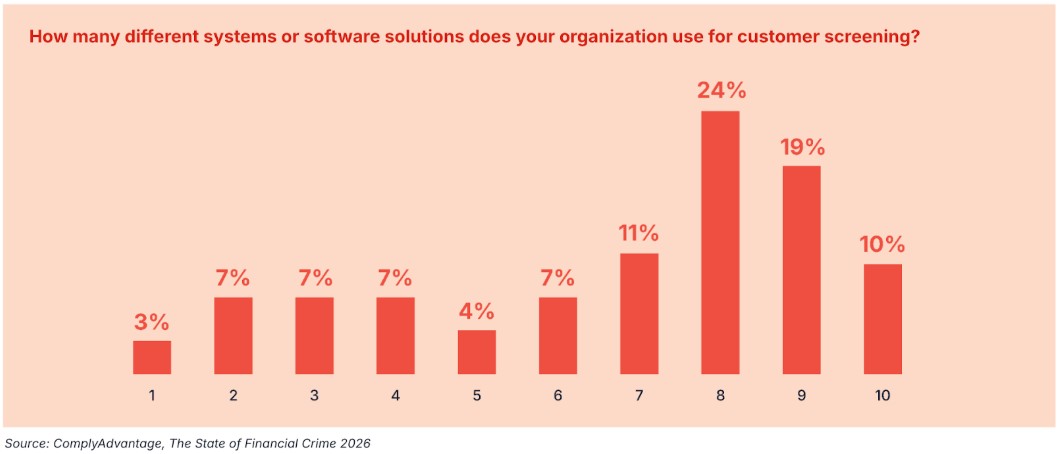
Programs should evolve across systems, processes, and people. On systems, the recurring failure is siloing, which can hinder better decisions. Globally, according to our State of Financial Crime 2026 research, 97% firms rely on two or more solutions for customer screening, with 65% in the APAC region managing between 8 and 10 separate systems.
“Many times, financial crime units work in silos, so they don’t have this layer on top to see what’s happening in the AML space, what’s happening in the fraud space.”
– Derrick Ong, Director, Financial Crime Strategy and Transformation, Trust Bank Singapore
Alert creation is only the first half of the job; the second is handling alerts well. So a well-placed call creates a cognitive break that snaps a customer out of a social engineering script.
Because APP and mule activity are two ends of the same chain, a holistic view of the customer is required, and this is what ComplyAdvantage Mesh helps tackle – drawing inferences from the activity of around 3,000 organizations globally.
Collaboration as the differentiator
Criminals already collaborate across borders, so should defenders. Industry-level sharing, through initiatives such as Singapore’s national scams register and interbank consortium data within personally identifiable information (PII) limits, is why detection has improved. The value lies in sharing actionable insight.
“Get AI to work for you. It can see, react, and bring information in real time at a pace at the same level as crime is being committed.”
– Ivan Zasarsky, Senior Managing Director, PwC South East Asia Consulting
The framing was operational rather than magical: models process signals and surface patterns, giving teams an even footing to act. The measure, throughout, was not reports filed but crimes stopped.
Three priorities for the next 12 months
- Layer iterative models on top of rules, with a feedback loop that retrains detection as typologies shift, rather than waiting weeks for rule changes.
- Unify fraud and AML into one view of the customer, and treat prevention – stopping money from leaving – as a first-class outcome alongside investigation and reporting.
- Invest in collaboration: contribute to consortium- and industry-wide data sharing within PII limits, and press for the space to interoperate signals across institutions.
A program you keep current, across systems, processes, and people, is what turns detection into prevention – and prevention is what protects both customers and the business that serves them.
Transform your AML compliance with AI-native solutions
A cloud-based compliance platform, ComplyAdvantage Mesh combines AML risk intelligence with actionable risk signals to screen customers and monitor their behavior in near real-time.
Get a demoOriginally published 24 July 2026, updated 24 July 2026
Disclaimer: This is for general information only. The information presented does not constitute legal advice. ComplyAdvantage accepts no responsibility for any information contained herein and disclaims and excludes any liability in respect of the contents or for action taken based on this information.
Copyright © 2026 IVXS UK Limited (trading as ComplyAdvantage).