

- Insights
- Featured Insights
As the financial crime (FinCrime) landscape continues to adopt new technologies and quickly mobilize attacks, so too must compliance modernize and evolve its defenses. The current status quo is not merely struggling – it’s failing to keep pace with adversaries who operate without the constraints of legacy systems.
This was the central theme of our flagship event series, CATALYST, which brought together hundreds of senior compliance professionals from across the industry to ask a vital question: What does the future of compliance look like?
In his session, ‘Compliance re-engineered for the age of AI’, ComplyAdvantage CEO, Vatsa Narasimha, highlighted that the only path forward is an essential shift from legacy systems to an AI-native platform built for agentic intelligence.
This transformation presents an immediate challenge, starting with the staggering economic and strategic risks now facing every leadership team.
1. The board-level crisis: AI-enabled crime
The statistics surrounding financial crime are no longer just operational concerns; they have become board-level crises. Approximately $2 trillion is laundered annually, equivalent to roughly one month of the US GDP. Despite the financial services industry spending an estimated $250 billion per year fighting this, less than 1% of illicit funds are actually detected and seized.
The urgency is compounded by adversaries that evolve faster than any regulatory body. In recent years, we have seen a 899% increase in AI-enabled crime. Criminals, unburdened by administrative strain, compliance officers, or legacy tech stacks, are adopting technology at a breakneck pace.
Criminals don’t have compliance officers. They adopt and adapt to technology way faster than law-abiding people can. The minute they find a weakness, it is circulated everywhere on the dark web.
Vatsa Narasimha, CEO at ComplyAdvantage
2. The problem: Disconnected data
The failure of the current status quo begins with a fundamental flaw: bad data and outdated infrastructure. Current anti-money laundering and counter-terrorist financing (AML/CFT) defences are often static “detection engines built for the flip phone era”. These legacy systems rely on outmoded keyword matching rather than contextual understanding.
When systems cannot distinguish between a soccer star “terrorising” a defence on the pitch and actual financial crime, they generate noise, forcing analysts to treat low-risk customers with the same scrutiny as known bad actors.
Yet, this data quality issue is only half the battle; the problem spirals because these noisy inputs are fed into a rigid and “bolted-on” infrastructure.
Reactive defenses, like building a twenty-foot wall, only create a market for a twenty-one-foot ladder. They make things difficult, but they do not solve the fundamental problem of innovation at the source.
Vatsa Narasimha, CEO at ComplyAdvantage

Watch all CATALYST sessions on-demand
Catch up with all the keynote speeches, fireside chats, and panel discussions from Catalyst. Hear exclusive insights from our expert speaker lineup on-demand.
Watch now3. The AI chasm: Why “bolted-on” AI is not enough
Many firms attempting to modernize hit what we call the “AI chasm.” This is a critical point that financial institutions (FIs) encounter when attempting to modernize their compliance frameworks.
Often, organizations apply a thin “agentic layer” of automation on top of siloed, legacy systems and poor data, bolting on automation rather than embracing full integration.
This legacy approach leaves firms vulnerable to three distinct structural limitations:
- The silo effect: Critical data remains trapped in isolated pockets, incapable of communicating across the organisation to spot complex, cross-channel patterns.
- The “bolted-on” trap: Many firms mistake adapting to AI for adopting AI, adding it as an external accessory rather than integrating it as a core part of their operating system.
- The “thin layer” mistake: Applying a superficial layer of automation yields only marginal gains, such as slightly reducing false positives from 90% to 75%. This can filter out the noise but fails to prevent the generation of false alerts at the source.
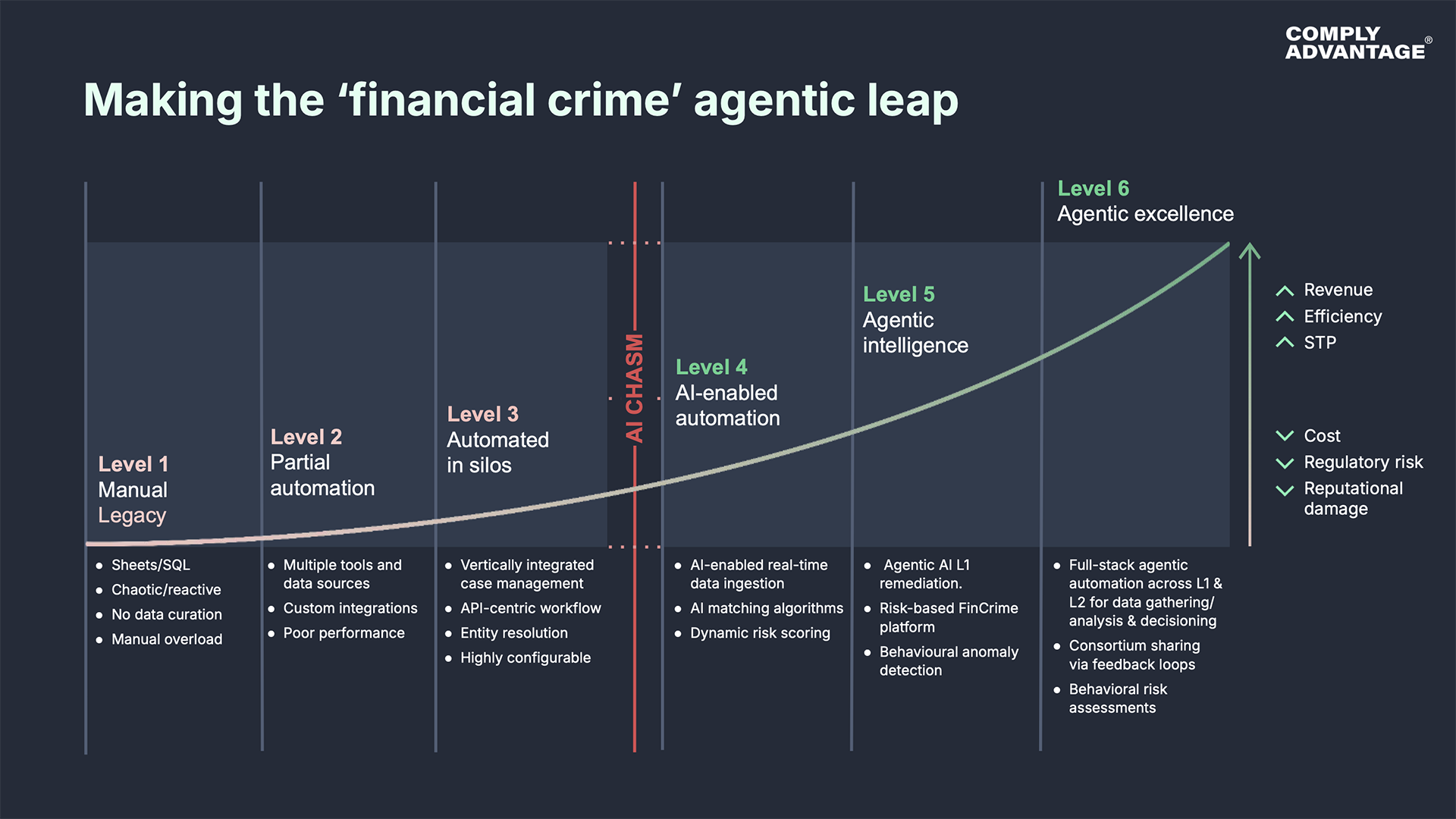
The operational reality created from these limitations is a fundamentally reactive compliance function. It creates a costly and noisy environment where teams are forced to manually piece together fragmented information, rather than proactively managing risk, “fighting the systems [rather than] fighting… criminals.”
Introducing Mesh: A unified platform for the AI age
To overcome these structural limitations, we developed ComplyAdvantage Mesh, a new AI-native platform that unifies customer and company screening, customer risk scoring, transaction monitoring, and real-time payments analysis into a single intelligent system. Built on large language and predictive machine learning models that deliver superior detection and scoring, Mesh leverages agentic AI to learn, act, and adapt across the full compliance lifecycle – transforming anti-financial crime programs from reactive cost centers into catalysts for growth.
The architecture of Mesh is designed for the era of agentic intelligence:
- The data layer: This proprietary intelligence layer forms the foundation of the platform, drawing essential FinCrime risk data and behavioral insights in real-time from sanctions lists, politically exposed persons (PEPs) / relatives and close associates (RCAs), adverse media, and transactional activity. This data informs a multidimensional risk framework that addresses all facets of financial crime risk, aligning with standards established by the Financial Crimes Enforcement Network (FinCEN), the Financial Action Task Force (FATF), the Sixth European Union Anti-Money Laundering Directive (AMLD6), and other global regulatory bodies. It uses an LLM-driven ingestion pipeline, which processes over 30 million documents daily, to conduct AI-based behavioral analysis and automated risk scoring that uncovers patterns missed by traditional systems.
- The risk apps: A highly configurable, API-first suite of applications for real-time screening, transaction monitoring, and real-time payments analysis – all connected to a central case management system that automates reporting, audit trails, and insights.
- The agentic layer: Mesh’s agentic AI layer orchestrates data, intelligence, and risk applications to deliver faster, smarter, and fully explainable compliance – automating detection, remediation, and regulatory filing while cutting false positives by 70% and speeding investigations by up to 84%.
Through optimising the levers within the system, we’ve been able to reduce our alert volume by 82%. This means we are able to pivot and reuse that resource in our highest risk areas of financial crime.
Laura Lehane, Head of Financial Crime and MLRO at AJ Bell
Crucially, Mesh prioritizes context. Rather than standard keyword matching, Mesh utilizes FinCrime-specific taxonomies to comprehend context and eliminate irrelevant noise, surfacing only genuine threats.
See Mesh in action
A cloud-based compliance platform, ComplyAdvantage Mesh combines industry-leading AML risk intelligence with actionable risk signals to screen customers and monitor their behavior in near real time.
Get a demoOriginally published 17 December 2025, updated 13 January 2026
Disclaimer: This is for general information only. The information presented does not constitute legal advice. ComplyAdvantage accepts no responsibility for any information contained herein and disclaims and excludes any liability in respect of the contents or for action taken based on this information.
Copyright © 2026 IVXS UK Limited (trading as ComplyAdvantage).