
- Insights
- Featured Insights
As we move through 2026, the landscape of financial crime has fundamentally shifted. The gap between criminal sophistication and firms’ legacy defenses has reached a breaking point. We’re no longer facing isolated threats, but an interconnected, industrialized criminal economy. These bad actors are weaponizing the very same technologies that companies rely on for growth and defense, creating an environment of unprecedented risk and complexity for compliance leaders.
To unpack these challenges, we hosted a webinar with leading experts who are on the front lines of this battle. The session, which drew insights from our global survey of 600 senior compliance leaders, featured Jessica Patel, Senior Product Manager at Funding Circle UK, and Crystal Noe, Chief Sanctions Officer & Head of On-Chain Product Compliance at Kraken. This blog outlines the key takeaways from their insightful discussion, from the rise of cyber-enabled crime to the regulatory pressures shaping the industry.
1. The convergence of threats: Cybercrime as the new underpinning
Financial crime has moved out of traditional silos, with cybercrime now acting as the primary engine driving organized crime and trafficking networks.
“Cybercrime underpins so many of the other financial crime types… it’s going to start facilitating the criminal capabilities that we see across all of the other elements.”
Jessica Patel, Senior Product Manager at Funding Circle UK
This digital shift is underscored by a “DeFi sanctions gap,” with evasion now representing roughly 39% of illicit crypto transaction volumes, as stated in Chainalysis’ 2025 report. State-sponsored actors from North Korea and Russia are increasingly weaponizing sophisticated engineering and synthetic identities to infiltrate financial systems, effectively “lighting gas to that fire” with the help of AI.
“AI is lighting gas to that fire… not only are we looking at cyber crimes, but these folks are applying at financial companies and appearing to be engineers to get access to these systems”.
Crystal Noe, Author and Chief Sanctions Officer & Head of On-Chain Product Compliance at Kraken
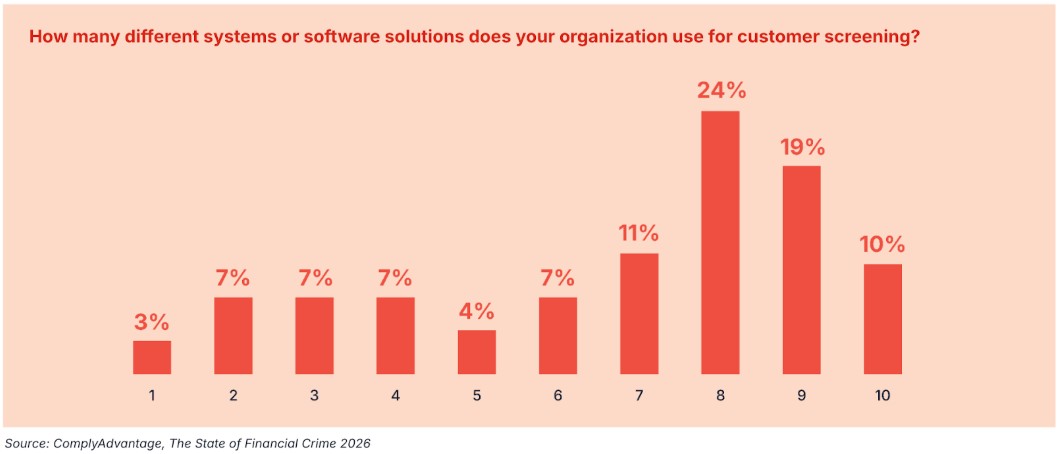
The “software sprawl” problem further complicates defense; despite 99% of firms agreeing that an integrated interface is essential, over half are still juggling 8 to 10 separate systems. This fragmentation creates “contextual blindness,” making it nearly impossible for analysts to build a cumulative picture of customer risk in real-time.
“If your compliance framework requires an analyst to go and retrieve context from all these disconnected systems… you’re making your decisions, you know, with a bag on your head”.
Iain Armstrong, Executive Director, FCC Strategy at ComplyAdvantage
2. The regulatory “push-and-pull”
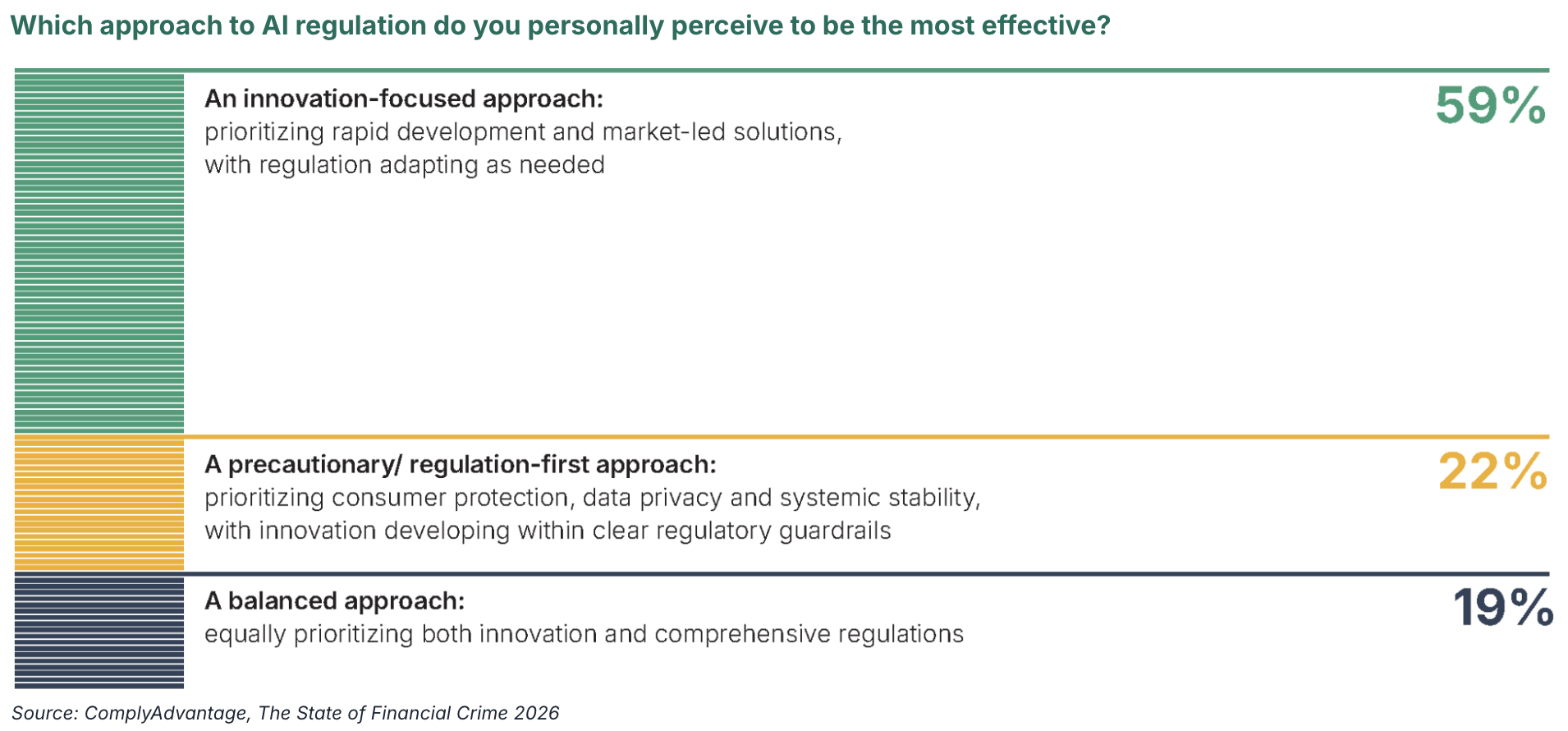
A significant dynamic in 2026 is the friction between the push for global standards and the realities of local enforcement. According to our industry survey, which specifically polled compliance leaders on their perceptions of AI-driven regulatory frameworks, 59% of respondents globally stated they favor an innovation-focused approach.
“Regulations don’t actually manage risk. We do… It’s really, really important for us to take the time to understand what the regulation is actually saying”.
Jessica Patel, Senior Product Manager at Funding Circle UK
While this majority leans toward progress, the data highlights a persistent tension: the desire to embrace new technology is still heavily balanced against the urgent need for robust, effective risk mitigation.
“We want regulations that don’t inhibit innovation… You may have all of the appropriate checks and balances in place, but are you really stopping financial crime?”
Andrew Davies, Global Head of FCC Strategy at ComplyAdvantage
This is especially true in the US, where 53% of firms show a lower appetite for innovation-led rules compared to the global average, often due to a history of heavy enforcement actions linked to systemic technical failures.
“In thirty-five years, I found at least 110 distinct typologies of technical failures that led to enforcement… We all want innovation, but when we look at our enforcement, it shows there is a lot of risk with that”.
Crystal Noe, Author and Chief Sanctions Officer & Head of On-Chain Product Compliance at Kraken
The State of Financial Crime 2026: Key findings for compliance leaders
Listen to compliance leaders sharing their views and main challenges in mitigating risk and shifting toward agentic excellence.
Watch on-demand3. The leap to agentic excellence
While 99% of firms have dedicated AI budgets, many are still transitioning to “agentic AI” – digital teammates that can reason and execute tasks. This technology is essential for addressing operator fatigue and the staggering volume of false positives that currently plague compliance teams.
“The case for agentic is definitely starting to get stronger and stronger by the day… that cognitive overload… burns you out, and you just become demoralized”.
Iain Armstrong, Executive Director, FCC Strategy at ComplyAdvantage
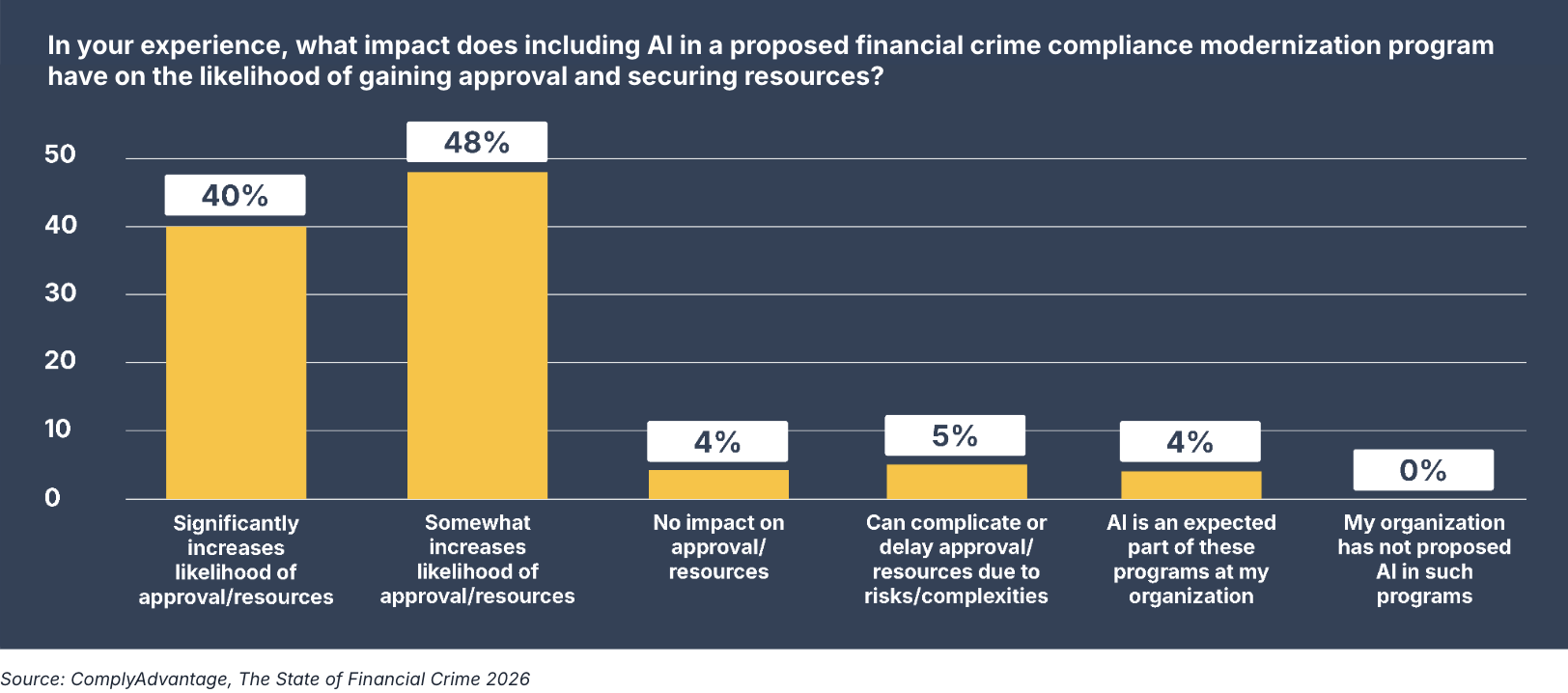
AI has become a massive investment signal, with 88% of organizations reporting that its inclusion in a proposal increases the likelihood of Board approval. However, leaders are cautioned to move beyond buzzwords toward clear, requirement-driven strategies.
“AI as a buzzword does increase the likelihood of funding being approved… but AI is a solution without a very well defined problem that it’s trying to solve”.
Jessica Patel, Senior Product Manager at Funding Circle UK
In a world of synthetic identities and deepfakes, human intuition remains vital, acting as a “spidey sense” that technology alone cannot replicate. AI should be used as a challenger model to question existing risk assessments and identify previously unseen blind spots.
“Step back and think about the new opportunities you have… Feeding your risk assessment into AI and asking, ‘Have I missed anything?'”. –
Crystal Noe, Author and Chief Sanctions Officer & Head of On-Chain Product Compliance at Kraken
Next steps
If you are a compliance leader, the single most important conversation to have with your Board is: “Are we scaling our compliance function by adding more people, or by adding more intelligence?”
In 2026, the winning strategy isn’t just about “improving” tools; it’s deploying autonomous agents that can sit across your entire stack and do the heavy lifting for you.
“You stop money laundering. You save lives. These are human stories.”
Andrew Davies, Global Head of FCC Strategy at ComplyAdvantage

The State of Financial Crime 2026
Get insights on financial crime trends from our global survey of 600 senior decision-makers and actionable takeaways from our Financial Crime Compliance Strategy team.
Download now
Originally published 19 March 2026, updated 25 March 2026
Disclaimer: This is for general information only. The information presented does not constitute legal advice. ComplyAdvantage accepts no responsibility for any information contained herein and disclaims and excludes any liability in respect of the contents or for action taken based on this information.
Copyright © 2026 IVXS UK Limited (trading as ComplyAdvantage).