

- Insights
- Featured Insights
For compliance, risk, and operations leaders, the challenge is ensuring the decisions your organization makes are defensible, consistent, and fast enough to support growth. The question worth asking is no longer ‘Do we have the data?’ but rather, ‘Is our intelligence quality high enough to protect our exposure and accelerate expansion?’
Yet, in the race to combat financial crime, manage risk, and rapidly expand into new markets, enterprises have continuously invested in complex, layered detection tools. An unintended consequence of this layered strategy is that it hasn’t always produced a unified view of risk. Instead, it has often led to a collection of siloed systems, creating a common, strategic problem across the enterprise: while each tool provides valuable data, the lack of communication between them means strategic decisions are often based on fragmented, rather than holistic, intelligence.
Our 2026 State of Financial Crime research found the scale of this problem – surveyed financial firms identified siloed datasets as the third most common limitation in their current approach to financial crime detection. Despite this, many continue to add tools rather than unify them, which only deepens the fragmentation. On average, organizations use seven different systems for compliance and financial crime risk management activities. Yet 99% of respondents said a single platform integrating AML, transaction monitoring, and payment screening would be helpful to their organization. This represents a massive gap between what firms have and what they know they need.
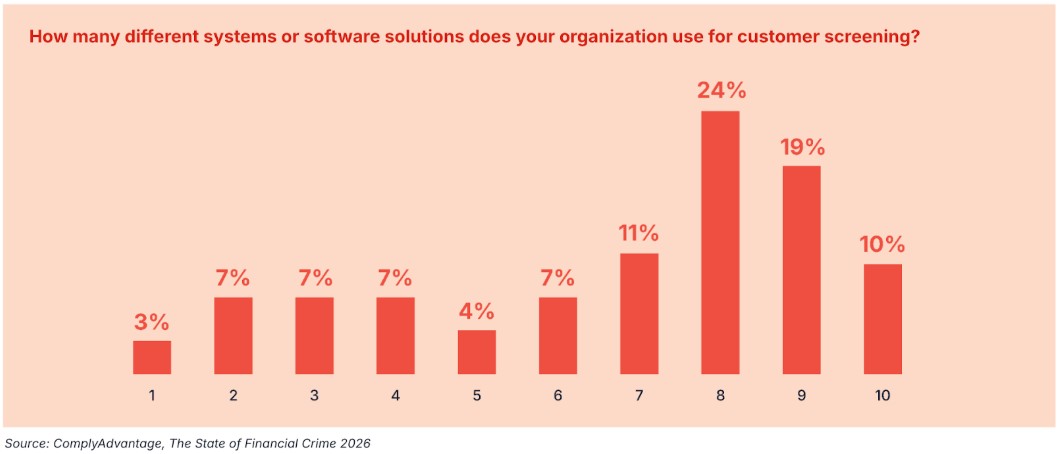
When risk signals are disconnected, they can jeopardize the entire customer lifecycle. Consider an analyst reviewing a flagged payment in real time: without a unified system, they have no visibility into that customer’s prior transaction patterns or earlier red flags resolved elsewhere. They’re making a high-stakes call on incomplete evidence. It’s in that gap – between what the analyst can see and what the data actually contains – that financial crime hides.
This article is for anyone who owns risk, cost, or growth decisions across the enterprise. It will help you audit your own tech stack for hidden risks, understand the new global legal standard for decision-making, and build a resilient compliance infrastructure that accelerates, rather than hinders, your enterprise growth.
How to identify the decision gap: Three failing pillars
Fragmented risk data clouds enterprises’ judgment and ability to make reasoned, evidence-based decisions. This weakness typically unfolds in three ways:
1. Silos as blind spots
When know your customer (KYC), anti-money laundering (AML), and fraud teams hold a different, incomplete picture of the same customer, no one can have the full story. Data sits in separate systems that don’t communicate with each other, so the connections that should trigger an alert never get made.
In this scenario, analysts waste time chasing noise in one system while genuine risk quietly develops in another. A customer who clears onboarding without an issue can become a serious liability overnight or weeks later. Not because the warning signs weren’t there, but because they were scattered across systems that no single analyst nor single alert could see all at once.
2. The velocity trap
In a high-growth enterprise, speed is your primary competitive advantage. The velocity trap is the paradox that emerges when your risk infrastructure actively works against that advantage.
Imagine your business tries to accelerate by launching a new product or entering a new market. This creates a surge in new customers and transactions. In a unified AML system, this is a good thing. But in a fragmented one, this surge of activity triggers a flood of alerts that your disconnected systems can’t resolve automatically.
This forces your teams into slow, manual detective work. Your most critical revenue-generating processes – customer onboarding, payment approvals – grind to a halt, stuck waiting for an analyst to manually connect the dots. The very growth you are chasing becomes the cause of the bottleneck that throttles it. That’s the trap: the faster you try to go, the more friction your systems create, and the slower you become.
“If your compliance framework requires an analyst to go and retrieve context from all these disconnected systems… you’re making your decisions with a bag on your head”.
Iain Armstrong, Executive Director, FCC Strategy at ComplyAdvantage
3. Operational scarcity
Operational scarcity happens when a technology failure forces you to divert your most valuable resources – capital and talent – away from growth.
In a fragmented program, you cannot automate accurate decisions at scale because your data is siloed. Every exception, every unresolved flag, and every unverified customer creates manual tasks that only a human can resolve by piecing together information. As your business grows, this manual workload doesn’t just increase; it compounds.
When bad decisions become illegal: A global perspective
Poor decision quality carries significant legal and financial consequences. Regulators are now looking past your data and into your decision logic, penalizing firms that cannot bridge the gap between isolated signals. From North America to Asia-Pacific, explainable decisions are increasingly becoming a legal requirement, not just best practice.
North America: The effectiveness test
- United States: The Financial Crimes Enforcement Network (FinCEN) is now fully focused on implementing the AML Act of 2020. It penalizes static compliance and requires intelligent monitoring that prioritizes high-value signals – which is impossible without unified data across KYC and transaction-monitoring systems.
- Canada: Under Bill C-12, penalties now reach up to $20M or 3% of global revenue. The Financial Transactions and Reports Analysis Centre of Canada FINTRAC’s effectiveness test specifically targets firms with fragmented systems that allow suspicious patterns to slip through the gaps between business units.
Europe & UK: Algorithmic accountability
- EU: With the EU AI Act fully in force, AI models used in financial crime detection are classified as high-risk, requiring full transparency from financial institutions (FIs). Simultaneously, the Anti-Money Laundering Authority (AMLA) views fragmented data silos as a failure of fundamental data governance.
- United Kingdom: The Financial Conduct Authority (FCA) and the Prudential Regulation Authority (PRA) both mandate operational resilience by aggressively targeting firms that cannot demonstrate a single view of the customer – especially where retail banking and payments overlap.
Asia-Pacific: Documented logic and systemic risk
- Singapore: The Monetary Authority of Singapore (MAS) has implemented its Fairness, Ethics, Accountability, and Transparency (FEAT) principles, requiring firms to explain the logic behind algorithmic decisions. You cannot be accountable for a decision if the data that fueled it is trapped in an inaccessible silo.
- Australia: The Australian Prudential Regulation Authority (APRA) issued risk management guidance requiring documented, end-to-end decision logic. APRA is scrutinizing opaque outcomes, pushing for systems where data lineage is fully auditable.
- Philippines: The Philippine Central Bank (BSP) and the Anti-Money Laundering Council (AMLC) 2026-2030 National Strategy mandate continuous account and transaction monitoring for FIs. Bangko Sentral-Supervised Financial Institutions (BSFIs) must monitor transactions against the customer’s full financial profile, not just isolated events.
- Malaysia: Bank Negara Malaysia (BNM) requires loss event data to be reconciled at the entity level, linking fragmented data explicitly to systemic risk ratings.
The solution: Moving to unified intelligence
From data to orchestration
Now that we’ve outlined what fragmented systems may cost you, let’s unpack what a unified view of risk actually solves, which all lies in the decision chain – a sequence of signals, enrichment, and judgments that sits between raw data and a confident compliance action.
In a fragmented environment, that chain breaks: data doesn’t flow between systems, context is lost across teams, and analysts spend their time manually piecing together a picture that a unified system would assemble automatically. ComplyAdvantage Mesh is built around a single, cohesive decision chain that addresses each of those failure points directly:
- Intelligent alert precision starts the process by eliminating noise at the source. Rather than flooding a triage team with low-quality matches, our matching engine uses machine learning to evaluate each alert against data points such as name rarity and date of birth, automatically resolving the vast majority of false positives before they reach a human analyst.
- Auto-remediation handles what remains. An autonomous AI agent steps in for matches that need closer inspection, acting as a virtual compliance team member within your existing workflow. It follows your firm’s specific risk logic and escalation thresholds thanks to a configurable, auditable process.
- Autonomous research and analysis means the agent does the heavy lifting traditionally carried by a Level 1 analyst: deep-diving into linked adverse media, relationships, and PEP status to determine whether a match is a genuine risk or a false positive.
- Natural-language reasoning reconnects disconnected systems. The agent synthesizes its findings into a clear narrative, documenting its full reasoning in an audit log, making every automated decision as transparent and defensible to a regulator as a human decision would be.
- Human-in-the-loop augmentation ensures that genuinely complex cases reach your experts, but with the work already done. If a case falls below a pre-set confidence threshold, it escalates to a human analyst with a fully prepared case file: evidence gathered, context assembled, reasoning documented. They make the final call; the system handles everything else.
Our Payment Screening capability shows this chain working end-to-end. Integrated natively into Mesh, it runs low-latency screening transactions, ensuring that flagged payments are never missed. The analyst reviewing that alert can see the customer’s complete history across every risk application in a single place, drastically enhancing decision-making.
“We have data, technology, and domain expertise that allows us to manage what I refer to as multiple dimensions of financial crime risk; it could be fraud, it could be money laundering, terrorist financing, human trafficking. […] What we’re doing with Mesh is bringing together all of these capabilities and data onto a single platform, to get a holistic view of financial crime risk at the relationship level. Sitting on top of unique data, all drawn together through a middle layer of entity resolution, are what we refer to as our risk apps; things like payment screening, transaction monitoring, customer screening, customer risk scoring, and detection for unusual activity that could be indicative of fraud.”
Andrew Davies, Global Head of Financial Crime Compliance Strategy at ComplyAdvantage
Listen to the full podcast (“What’s Finally Changing to Help Catch More Financial Crime With Andrew Davies of ComplyAdvantage“, episode #587) hosted by Peter Renton:
Infrastructure as a growth enabler
Once your risk infrastructure is unified, compliance stops being a hurdle to your company’s growth and provides:
- End-to-end data ownership: By having visibility into the data lifecycle from source to alert, you can identify threats in real time. With critical sanctions lists updated in minutes, not hours, your decisions are always based on the freshest intelligence available.
- Autonomy and precision: AI-driven automation and no-code configurability let you calibrate the system to your specific risk appetite without depending on engineering teams. This eliminates noise from fragmented systems, freeing your teams to focus on genuine threats.
- Operational resilience: Connecting customer screening, transaction monitoring, and risk scoring creates a holistic view of your customer lifecycle. A risk signal in payments automatically informs the customer’s full risk profile, with nothing slipping through the gaps between systems.
Next steps: Looking deeper at your intelligence infrastructure
The status quo in FinCrime prevention is no longer sustainable. For many enterprises, compliance has become a trail of inconsistent, fragmented decisions masked by overwhelming data volumes. If your team is spending more time reconciling signals between silos than proactively managing risk, your infrastructure is slowing your ability to scale.
Moving to a unified system like ComplyAdvantage Mesh prevents compounding errors and gives your organization a robust foundation for enterprise risk control – one that lets you move faster, enter new markets with confidence, and maintain a rigorous global risk posture.
Questions for the strategic leader:
- Audit your decision logic: Are your KYC, AML, and payment signals truly unified, or are you making critical decisions based on partial information?
- Assess your global posture: Can you explain the end-to-end logic of an algorithmic decision to a regulator in Singapore, London, or New York tomorrow?
- Evaluate your growth ceiling: Is your current technical debt from disconnected silos preventing you from scaling operations?
Unify your enterprise risk intelligence to control and accelerate growth with Mesh
A cloud-based compliance platform, ComplyAdvantage Mesh combines industry-leading AML risk intelligence with actionable risk signals to screen customers and monitor their behavior in near real time.
Get a demoOriginally published 27 May 2026, updated 12 June 2026
Disclaimer: This is for general information only. The information presented does not constitute legal advice. ComplyAdvantage accepts no responsibility for any information contained herein and disclaims and excludes any liability in respect of the contents or for action taken based on this information.
Copyright © 2026 IVXS UK Limited (trading as ComplyAdvantage).