
- Insights
- Featured Insights
The sixth and final Financial Action Task Force (FATF) Plenary meeting under the Mexican Presidency of Elisa de Anda Madrazo took place in Paris from June 17-19, 2026. Delegates from across the FATF’s Global Network of more than 200 jurisdictions and observers gathered to discuss evolving threats to financial integrity and to agree a range of initiatives to strengthen the global response to illicit finance.
Highlights from the plenary include:
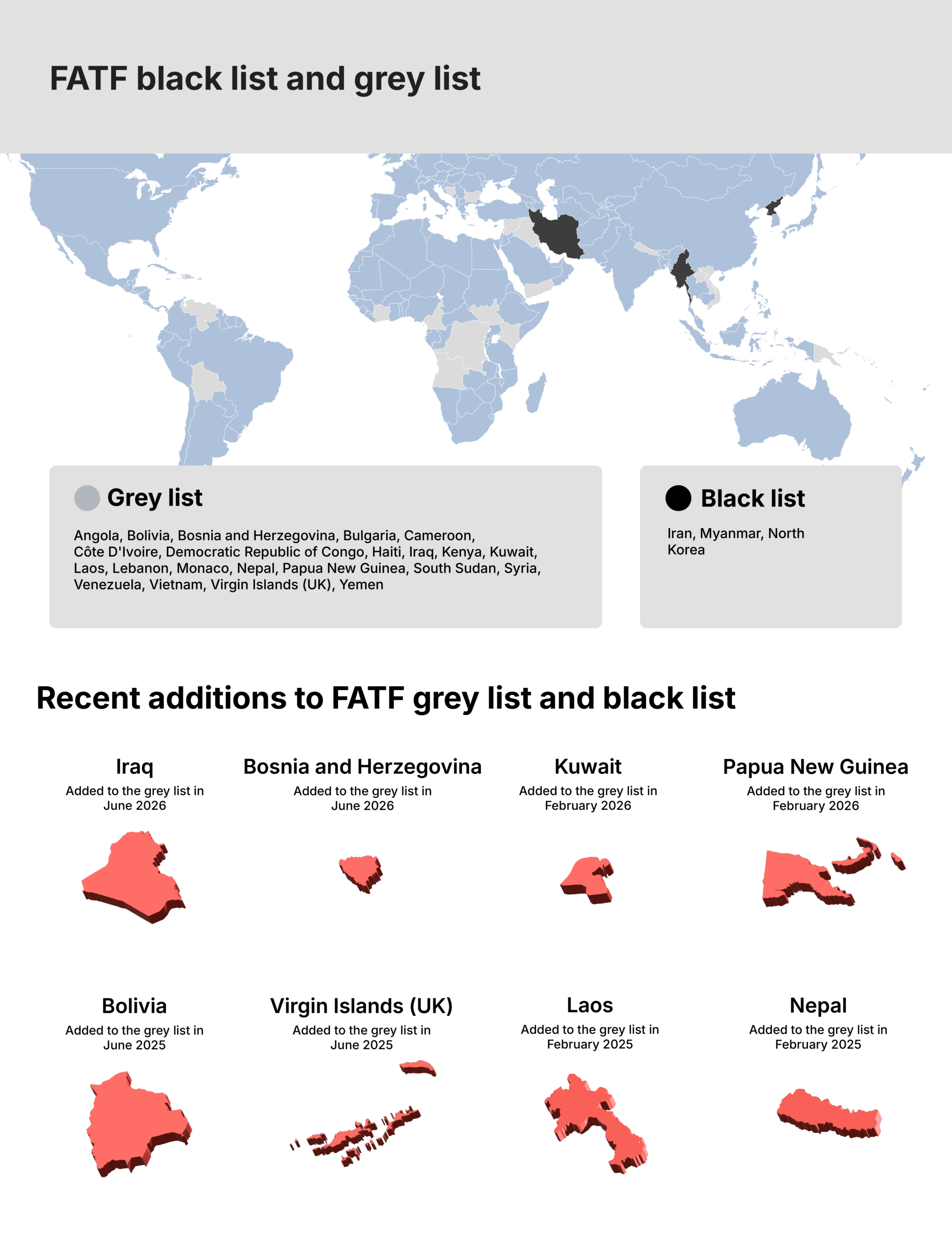
- Changes to the FATF grey list: Bosnia and Herzegovina and Iraq were added to the list of jurisdictions under increased monitoring, while Algeria and Namibia were removed.
- A strengthened Standard: an update to Recommendation 6 to protect humanitarian assistance from the unintended effects of sanctions.
- New publications and consultations: including a public consultation on guidance for the strengthened cross-border payment transparency Standard, Recommendation 16.
- Mutual evaluations: the adoption of the reports for Canada and Türkiye.
- A leadership transition: priorities confirmed for the incoming UK Presidency, the appointment of a new Vice-President, and the launch of a new Global Strategy Group.
This article breaks down the key takeaways from the event, including what they mean for your business.
1. Changes to the grey list
The FATF’s list of jurisdictions under increased monitoring, or the “grey list,” is a key reference point for compliance professionals. At the June 2026 plenary, two countries were added, and two were removed, leaving 22 jurisdictions under increased monitoring.
Additions
Bosnia and Herzegovina
Bosnia and Herzegovina was added to the grey list following the Council of Europe’s MONEYVAL mutual evaluation, published in December 2024, which identified strategic deficiencies in its regime. The country has made a high-level political commitment to an action plan that focuses on deepening its understanding of money laundering and terrorist financing risks, strengthening the supervision of designated non-financial businesses and professions (DNFBPs), applying proportionate and dissuasive sanctions, and ensuring the timely availability of accurate, up-to-date beneficial ownership information. It is also expected to increase money laundering investigations and prosecutions and to pursue terrorist financing cases more proactively. A recurring concern is the absence of a comprehensive, operational beneficial ownership register, which limits transparency over legal entities in higher-risk sectors.
Iraq
Iraq returns to increased monitoring, having previously been under FATF monitoring from 2013 to 2018. With a population of roughly 48 million, it is among the largest jurisdictions added to the list in recent years. Announcing the decision, FATF President Elisa de Anda Madrazo pointed to the risks associated with Iraq’s cash-intensive economy and the need for the country to strengthen money laundering investigations, increase prosecutions, and make greater use of financial intelligence. Iraq has made a high-level political commitment to work with the FATF and its FATF-Style Regional Body, MENAFATF, to address these deficiencies within agreed timeframes.
Removals
Algeria
Algeria was added to the grey list in October 2024, following its mutual evaluation, which identified gaps in risk-based supervision, beneficial ownership transparency, and the investigation and prosecution of money laundering and terrorist financing. Following a successful on-site visit, the FATF removed it in June 2026, recognizing the progress made against that action plan. Algeria strengthened risk-based supervision, improved the transparency of company beneficial ownership, and enhanced its implementation of targeted financial sanctions, alongside closer oversight of its banking, customs, and tax systems and tighter monitoring of cross-border financial flows. It will continue to work with its FATF-Style Regional Body (FSRB), MENAFATF, to sustain these improvements.
Namibia
Namibia was added to the grey list in February 2024, after the FATF identified 13 strategic deficiencies across its AML/CFT and counter-proliferation-financing framework, with an action plan due to be completed by May 2026. The country addressed substantially all of those items ahead of the deadline, clearing the way for an on-site assessment and its removal in June 2026. The FATF highlighted Namibia’s enhanced risk-based supervision across the financial and non-financial sectors, and an increase in investigations and prosecutions of serious and complex money laundering cases. Namibia will continue to work with its FSRB, ESAAMLG.
There were no changes to the FATF’s list of jurisdictions subject to a call for action, or the “black list,” which continues to consist of the Democratic People’s Republic of Korea, Iran, and Myanmar.
A Guide to the FATF Grey List
The FATF grey list is among the best-known indices of higher-risk countries in the compliance industry. But how should firms respond to a grey listing in practice?
Download now2. A strengthened Standard: Protecting humanitarian assistance
The Plenary updated Recommendation 6 of the FATF Standards to help ensure that sanctions measures do not block the funds, assets, resources, goods, and services needed for humanitarian assistance and to meet basic human needs. The update incorporates the humanitarian exemption set out in United Nations Security Council Resolutions 2664 and 2761, which relate to the prevention and suppression of terrorism and terrorist financing. For firms, the change reinforces the expectation that sanctions screening and controls should be calibrated to avoid disrupting legitimate humanitarian flows.
3. Strategic initiatives
The FATF approved a series of publications and initiatives to help countries and the private sector respond to emerging risks. Several are directly relevant to payments and banking institutions.
Cross-border payment transparency
The Plenary approved a public consultation on new guidance supporting the strengthened FATF Standard on cross-border payment transparency, Recommendation 16. The guidance is intended to help countries and financial institutions improve payment transparency to combat money laundering, terrorist financing, proliferation financing, and predicate crimes, with a particular focus on fraud. Stakeholders will be able to respond to the consultation from the week of June 22, 2026.
Public-private partnership and information sharing
The Plenary approved a new Global Overview of Public and Private Sector Partnerships and Data Protection Arrangements, due to be published in July 2026. The publication will set out different models of information sharing from around the world, with the aim of supporting actionable intelligence sharing that remains aligned with data protection requirements. Further work in this area will continue under the UK Presidency.
Terrorist financing through digital platforms
A new publication on detecting and disrupting terrorist financing conducted through social media, instant messaging applications, and streaming platforms was approved. Building on the FATF’s 2025 Comprehensive Update on Terrorist Financing Risks, it sets out how these technologies are being misused and recommends mitigation measures, including more proactive engagement with the relevant sectors.
Underground banking and other evolving threats
The Plenary approved a report scheduled for September 2026 that examines how underground banking, hawala, and similar service providers can be exploited by criminal actors, including professional money launderers. The FATF also approved work to update its understanding of illicit finance risks in the casino and broader gambling sector, including new risk indicators, as these industries expand across online, cross-border, and multi-payment platforms.
Virtual assets and decentralized finance
As part of its continued focus on the virtual asset sector, the FATF approved a seventh targeted update on the implementation of its Standards on virtual assets (VAs) and virtual asset service providers (VASPs). A new targeted report will also examine the regulatory challenges posed by decentralized finance (DeFi) platforms and their potential exposure to money laundering, terrorist financing, and proliferation financing risks. Both reports are due to be published in July 2026.
4. Mutual evaluations of Canada and Türkiye
The Plenary discussed and adopted the reports of the joint FATF-Asia/Pacific Group (APG) mutual evaluation of Canada and the FATF mutual evaluation of Türkiye. These reports assess the effectiveness of each country’s measures against money laundering, terrorist financing, and proliferation financing, and their compliance with the FATF Recommendations. They are scheduled for publication between September and October 2026, following a Global Network quality and consistency review. Under the new round of mutual evaluations, assessed countries receive a time-bound Roadmap of Key Recommended Actions to strengthen their defenses within three years.
5. A leadership transition and the incoming UK Presidency
The June 2026 plenary was the last under the Mexican Presidency of Elisa de Anda Madrazo, whose term concludes on June 30, 2026.
Incoming President Giles Thomson of the United Kingdom presented the UK Presidency’s priorities, which run from July 1, 2026, to June 30, 2028. In line with the strategic priorities agreed at the FATF Ministerial in Washington, DC, the UK Presidency will focus on three areas:
- Stepping up the international response to fraud, including the money laundering and terrorist financing risks linked to scam compounds.
- Strengthening implementation of the risk-based approach and risk-based supervision.
- Enhancing information sharing and public-private partnerships.
The Plenary also appointed Vivek Aggarwal of India as the incoming Vice-President for the period July 2026 to June 2027. Mr. Aggarwal is Secretary to the Government of India at the Ministry of Culture and a former Head of the Indian Delegation to the FATF.
6. Strengthening the Global Network
The Plenary launched a new Global Strategy Group, which held its inaugural meeting on June 15, 2026. Chaired by the FATF President and bringing together the chairs of FATF-Style Regional Bodies, the group will strengthen coordination across the Global Network and advise on strategic issues such as cross-regional risks.
The FATF welcomed the Alliance for Financial Inclusion (AFI) as a new observer. AFI is a member-led network of central banks and financial regulators across 83 developing economies, and its participation is intended to support implementation of the FATF Standards in line with a risk-based approach that advances financial inclusion. The Plenary also welcomed the continued participation of Jamaica and Nigeria under their own flags through the FSRB Guest Initiative. The FATF’s suspension of the Russian Federation, in place since February 2024, remains in effect.
Next steps
Compliance teams should update their country risk assessments to reflect the latest grey list changes, applying enhanced due diligence to Bosnia and Herzegovina and Iraq, and reviewing the risk scores and controls applied to Algeria and Namibia following their removal. Our in-depth guide to the FATF grey list explains how a country’s status should be reflected in compliance policies.
Payments and banking institutions should pay particular attention to the forthcoming consultation on cross-border payment transparency under Recommendation 16, which offers an opportunity to shape guidance that will directly affect payment screening and data requirements. With fraud set to be a defining theme of the UK Presidency, firms should also assess how well their current systems detect and disrupt fraud and the financial crime risks that accompany it. Legacy tools often struggle to combine this level of detection with the efficiency and auditability that operations teams and regulators now expect; AI-driven screening and monitoring can help close that gap while keeping decisions explainable.
The next FATF plenary, the first under the UK Presidency, is scheduled for October 2026.
The State of Financial Crime 2026
Get insights on financial crime trends from our global survey of 600 senior decision-makers, with expert guidance from our Financial Crime Compliance Strategy team.
Download nowOriginally published 22 June 2026, updated 22 June 2026
Disclaimer: This is for general information only. The information presented does not constitute legal advice. ComplyAdvantage accepts no responsibility for any information contained herein and disclaims and excludes any liability in respect of the contents or for action taken based on this information.
Copyright © 2026 IVXS UK Limited (trading as ComplyAdvantage).