

- Insights
- Featured Insights
Legacy anti-money laundering (AML) tools were designed for overnight batch processing, static rules, and manual alert review. But they’re no longer compatible with today’s financial firms’ (FIs) compliance requirements and regulators’ scrutiny.
Real-time payment rails, cross-border complexity, and rapidly evolving financial crime typologies demand an AML risk-detection platform built from the ground up on artificial intelligence (AI).
ComplyAdvantage is that platform. We apply AI across the full financial crime risk management lifecycle – from initial due diligence through ongoing screening and monitoring to remediation and reporting – with specific, named techniques rather than vague AI‑powered features.
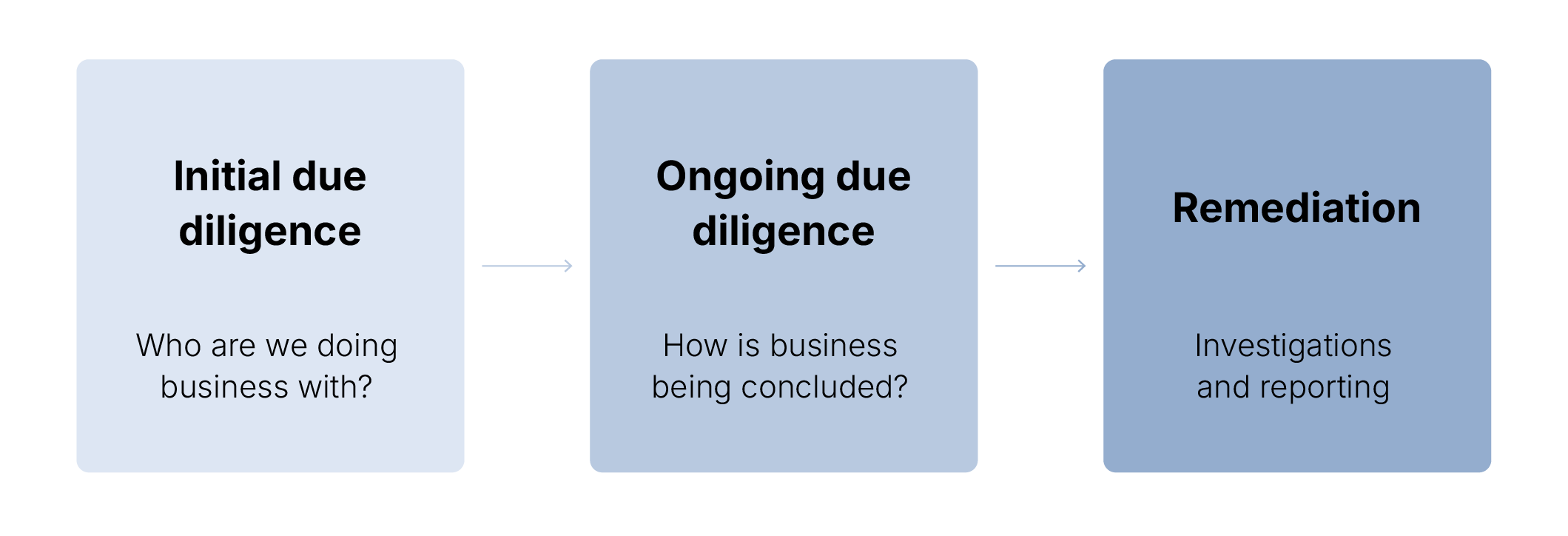
At every stage, supported by our powerful risk intelligence data, we deploy specific, named AI techniques – natural language processing (NLP), entity resolution, probabilistic scoring, agentic AI, and generative AI – rather than relying on generic AI-powered features that lack technical substance.
|
Lifecycle stage |
Core focus | ComplyAdvantage AI techniques |
|
Initial due diligence Who are we doing business with? |
Understanding risk at onboarding |
LLM‑based adverse media classification, curated and prioritized sanctions/PEP/adverse media ingestion, entity resolution and clustering probabilistic scoring using next‑generation risk models, and dynamic customer risk profiles. |
|
Ongoing due diligence How is business being concluded? |
Monitoring relationships as they evolve |
Continuous screening, advanced detectors for sanctions, politically exposed persons (PEPs), fraud, and predicate offenses, behavioral monitoring across payment rails, non‑transactional risk signals, and AI‑assisted scenario management. |
|
Remediation Investigations and reporting |
Resolving alerts with confidence |
Agentic AI that automates large parts of profile remediation, with configurable options for end‑to‑end case handling, detailed audit‑ready narratives, and generative AI to streamline suspicious transaction report (STR) preparation. |
Banks, FinTechs, payment firms, and crypto platforms rely on ComplyAdvantage to move from noisy, rules‑only workflows to an AI‑native AML risk detection platform that scales with their business – reducing false positives, increasing analyst productivity, and providing the explainability regulators expect.
This article explains how ComplyAdvantage used AI at each lifecycle stage, the governance and auditability built into our models, and the measurable results our customers achieve in production.
The financial crime risk management lifecycle
How we use AI during initial due diligence
Initial due diligence focuses on understanding the risk associated with new business relationships. This is where screening accuracy directly determines both compliance outcomes and customer experience. Imprecise screening delays onboarding, frustrates legitimate customers, and generates false positive alerts that consume analyst time without producing intelligence.
Our AI capabilities at this stage operate across four layers:
- AI-agent-powered data collection: A global network of AI agents continuously collects information from primary regulatory and risk sources – sanctions and watchlists, politically exposed persons (PEPs), Heads of International Organizations (HIOs), and other statutory lists, plus adverse media – by connecting directly to first‑source publications and monitoring them with AI agents. Rather than relying on delayed batch updates, changes are detected and ingested into a structured schema in near real time.
- Language learning models (LLMs) and NLP for data curation: Instead of simple keyword matching, we use language models that read the full text of articles, determine each entity’s role (perpetrator, victim, or official), and classify risk into Financial Action Task Force (FATF)‑aligned sub‑types across multiple languages. This context‑aware approach filters out noise – such as sports metaphors or mentions of journalists and police – and surfaces genuinely material adverse events.
- Entity resolution and clustering: Curated data is then passed through these processes, which determine whether multiple data points refer to the same real‑world person or organization. By comparing structured identifiers – such as dates of birth and other secondary fields – our engine can, in milliseconds, defensibly clear a legitimate “Robert Smith” when the sanctioned individual’s profile clearly does not match, rather than opening duplicate manual alerts.
- Probabilistic, context-aware scoring: Screening decisions are driven by probabilistic scoring that goes far beyond simple string similarity. Matching blends exact, fuzzy, and phonetic algorithms with models that estimate the “likelihood to escalate” based on millions of historic decisions, adjust for name commonness, and use rich negative evidence from structured data to reduce false positives while maintaining defensible risk coverage.
AI agents are components that use LLMs/automation to perform specific tasks (e.g., ingesting and classifying articles, scoring risk, generating notes). These exist throughout the platform and data pipelines.
Agentic AI , on the other hand, refers to a branded concept tied to auto-remediation and end-to-end workflows where an AI “analyst” reasons over evidence, makes a decision, and documents it with strong governance and safety constraints.
This multi-layered approach – AI-agent-powered data collection, AI-driven language understanding, entity resolution, and probabilistic scoring – has helped ComplyAdvantage customers reduce false positives by around 60%, cut noise by more than 80% compared with legacy platforms, and reduce onboarding times by up to 60% in production deployments.
Our initial due diligence capabilities also include customer risk scoring, which combines static customer information (such as geographic and demographic data) with real-time screening results to provide a dynamic overall risk score. Financial institutions can calibrate this score to their own risk tolerance, triggering enhanced due diligence (EDD) where warranted, while streamlining low-risk onboarding.
“With ComplyAdvantage, we can have extremely segmented and sophisticated rules that allow us to spot the most sophisticated fraudulent networks.”
Valentina Butera, Head of AML and AFC Operations, Holvi

Business brief: Agentic AI and AML compliance
Download your copyHow we use AI during ongoing due diligence
Customer risk profiles are not static. A customer onboarded with a low-risk score may later be added to a sanctions list or linked to new adverse media. Ongoing due diligence requires continuous, automated monitoring that detects these changes as they happen – across four capabilities:
- Continuous screening against evolving data: The same AI-collected and curated data used during onboarding – sanctions lists, PEPs, watchlists, media publications, and custom lists – is continuously refreshed and made available via dynamic screening configurations. New risk types, data sources, and jurisdictions are surfaced through the Risk Catalog Service, so monitoring automatically keeps pace with sanctions updates and emerging financial crime risks.
- AI-native detection and configuration: On ComplyAdvantage Mesh, advanced machine learning models for fraud and AML work alongside rules to analyze transactional behavior, clustering, and graph patterns, while an AI-based scenario manager lets compliance teams define and update detection logic in natural language instead of code. This combination makes it faster to introduce new scenarios as financial crime methods evolve, without relying on engineering change tickets.
- Risk-aligned screening configurations: Screening configurations give firms granular control over which risk types (for example, sanctions exposure, political exposure, money laundering predicate offenses, fraud), data sources, jurisdictions, and match thresholds apply to each customer segment. This lets teams cast a wider net for high-risk segments and tighter thresholds for lower-risk ones, reducing false positives while ensuring ongoing monitoring remains aligned with global standards such as FATF and the European Union Anti-Money Laundering Directive (EU AMLD).
- Case management and alert handling: Across Payment Screening and Transaction Monitoring, alerts flow into the Mesh Case Manager, where analysts can triage, investigate, mute confirmed false-positive profiles, and maintain a complete audit trail. Muting suppresses repeat alerts for previously-cleared matches while still screening those parties on every transaction, so analysts focus on genuinely emerging risk rather than reworking the same noise.
“ComplyAdvantage has saved our analysts about 50% of the time they previously spent on transaction monitoring. The system has helped us dramatically reduce our false positives, and has also given us the ability to adjust rules in real-time to fit what we need.”
Connor McNulty, Vice President of Legal and Chief Compliance Officer, PayNearMe
How we use AI during remediation and reporting
The remediation and reporting stage is where investigations are conducted, cases are resolved, and regulators and law enforcement are informed of suspicious activity. For many compliance teams, this stage consumes the most analyst time – and it is where the impact of agentic AI is most measurable, across:
- Agentic AI for alert and case remediation: Our AI co‑pilot was built natively inside Mesh. It can remediate large volumes of low‑risk profiles within customer screening and monitoring cases – reviewing all available customer and profile data, applying configured decision logic, and leaving a detailed, auditable rationale for each profile. Clients can choose whether the agent:
- Remediates profiles only, or
- Remediates profiles and automatically closes cases end‑to‑end when all profiles are marked as false positives.
The agent does not close cases; human analysts remain responsible for final case closure unless clients explicitly configure otherwise. Across early adopters, agentic auto‑remediation has automated 65–85% of Level 1 profile reviews and, in combination with next‑generation data, reduced alert noise by up to 95% while cutting onboarding times by up to 50%.
- Agentic AI for case enrichment: Before an analyst begins an investigation, the agent can assemble and reason over all relevant information already held in Mesh – customer attributes, risk profiles, sanctions/PEP/adverse media hits, and prior case notes – and produce structured explanations. This removes much of the manual evidence gathering that typically dominates the first part of an investigation, so analysts start from a clear, explainable narrative rather than a blank screen.
- Learning from investigation outcomes: Across our risk applications, all agent and analyst actions are captured in our Mesh Case Manager’s audit log. This unified record provides the foundation for ongoing tuning of screening configurations, risk types, and detection scenarios, enabling teams to define new scenarios in natural language and deploy them faster with full transparency.
“ComplyAdvantage gives me a high degree of control via various reports and the case management system. It is easy to generate reports, which enable quick audit reviews and greater visibility into the data.”
– Head of Client Onboarding (Lending), OakNorth Bank
How we ensure our AI is trustworthy and effective
Deploying AI at scale in a regulated environment demands more than technical performance. Regulators, auditors, and compliance leaders need confidence that AI‑driven decisions are fair, transparent, and defensible. ComplyAdvantage addresses this through a risk‑based, federated AI governance framework – built into the product, not bolted on – and a set of Responsible AI principles that map directly to named regulations. These principles include:
1. Explainable and governed AI
Every production model at ComplyAdvantage has a named model owner (MO), a signed model requirements document (MRD), a risk rating, and a defined review cadence. No model goes live without model review board (MRB) approval, and we can produce the signed MRD for any production model on request, typically within 24 hours.
Our Responsible AI framework is structured around eight principles – including fairness, transparency, explainability, risk assessment, risk mitigation, accountability, empowered oversight, and contestability – each tied to concrete controls in the model risk management (MRM) framework.
2. Responsible AI in practice
ComplyAdvantage operates a risk‑based, federated governance model: central teams (Data Governance, Regulatory Affairs, MRB) set policy and standards, while local model owners and model governance analysts carry day‑to‑day controls and independent validation. This mirrors how banks govern credit‑risk models and is the pattern regulators expect.
Every model moves through a seven‑stage lifecycle – design, build, test, go‑live, monitoring, upgrade, and end‑of‑life – with explicit stage gates, monitoring for drift and performance, and documented decommissioning. Annual external review and thematic reviews provide additional assurance that governance operates in practice, not just on paper.
3. High‑quality, curated data
AI is only as good as its data. Our adverse‑media pipeline ingests around 8 million articles per day from more than 11,000 curated domains across 11 languages (English + 10), selected and maintained by our International Affairs Research Analysts (IARA) team following guidance from the European Banking Authority (EBA) and the Wolfsberg Group.
Instead of maximizing raw domain counts, we optimize for relevance and credibility: international, national, and regional news; judiciary and public‑authority sites; police blotters; and specialist industry sources. A dual‑channel ingestion engine and two‑phase deduplication ensure that each unique article is processed once before the LLM pipeline classifies entities, crimes, and snippets.
4. Financial crime data experts
Technology alone does not solve financial crime. ComplyAdvantage’s data and AI teams work alongside domain experts dedicated to financial crime, regulatory developments, and global risk data. This is reflected in our fincrime‑purposed governance framework, our FATF‑aligned risk sub‑types, and the way our models and data schemas are designed specifically for sanctions, PEPs, adverse media, and transaction risk – rather than generic analytics use cases.
5. What ComplyAdvantage does and does not replace
ComplyAdvantage is purpose‑built for operational financial crime compliance: screening, monitoring, detection, case management, and reporting within a single, unified platform. Our framework aligns with the standards your audit and model‑risk teams expect.
We integrate into broader architectures where firms use complementary tools for contract lifecycle management (CLM), know your customer (KYC) orchestration, or enterprise risk. In practice, many in‑house teams leverage our governance, external review, and regulatory mapping as a partner to their own frameworks, rather than replacing them outright.
6. Agentic AI in a regulated context
Agentic AI is governance‑different: the key question from buyers has shifted from “how accurate is your model?” to “what stops your agent from doing something neither of us authorized?”
ComplyAdvantage answers this with:
- An agent that operates on a safety‑first principle: It marks profiles as false positives only when it finds definitive, explainable conflicts and otherwise returns not reviewed for human escalation; true positives remain a human decision.
- An agent design that emphasizes detailed notes: Explaining why actions were taken, so decisions are traceable and auditable.
- Extended risk domains (security, resilience, privacy, performance, auditability): Within the standard MRM framework, plus guardrails such as LLM‑as‑a‑judge and access limitations.
What ComplyAdvantage AI delivers: Measurable outcomes
The purpose of AI in financial crime compliance is to deliver measurable improvements in speed, accuracy, and operational efficiency without sacrificing explainability or control. Across the lifecycle, internal and customer evidence support the following outcomes:
- False positives and noise reduction: Next‑generation data and probabilistic scoring have delivered around a 60% reduction in false positives and “better than 80% noise reduction” compared with legacy platforms.
- Adverse media quality: For adverse media specifically, version‑3 pipelines and LLM‑based classification have reduced false positives by 43–50%, halved the information analysts must review, and produced snippets judged sufficient in 98% of UAT cases.
- Automation and analyst productivity: Agentic auto‑remediation currently automates about 65–85% of profiles or cases, depending on risk appetite, and has enabled Level‑1 analysts to become 85–90% more productive in production deployments.
- Onboarding speed: One client has cut onboarding times by around 60% using Mesh and automation agents, transforming compliance from a bottleneck into an enabler of growth.
- Investigation efficiency: For complex investigations, advanced ML models and graph analysis have reduced research time by roughly 70%, while maintaining “white‑box” explainability so investigators can see how each decision was made.
Together, these outcomes reflect a structural difference between an AI‑native AML platform – where ingestion, scoring, remediation, and governance are designed as a single system – and legacy stacks, where AI is an add‑on to batch rules and stale data.
For compliance leaders, this translates into teams that handle higher volumes without adding headcount, analysts who spend their time on genuine risk rather than clearing noise, and a compliance function that scales with the business instead of constraining it.
Transform your AML compliance with AI-powered solutions
A cloud-based compliance platform, ComplyAdvantage Mesh combines industry-leading AML risk intelligence with actionable risk signals to screen customers and monitor their behavior in near real time.
Get a demoOriginally published 18 June 2025, updated 08 July 2026
Disclaimer: This is for general information only. The information presented does not constitute legal advice. ComplyAdvantage accepts no responsibility for any information contained herein and disclaims and excludes any liability in respect of the contents or for action taken based on this information.
Copyright © 2026 IVXS UK Limited (trading as ComplyAdvantage).