

- Insights
- Featured Insights
The Financial Action Task Force (FATF) held its October 2026 plenary in Paris from October 28 to 30, 2026, the first plenary under the UK Presidency of Giles Thomson, who took over from the Mexican Presidency at the end of June 2026.
Delegates from more than 200 jurisdictions and observers attended. Barbados, Namibia, and Thailand also took part under their own flags for the first time, through the FATF Guest Initiative.
Highlights:
- Grey list: Bulgaria, Côte d’Ivoire, the Democratic Republic of the Congo, and Monaco were removed. No jurisdictions were added.
- Vietnam: The FATF expressed significant concern about Vietnam’s pace of progress and will consider next steps if it doesn’t see tangible improvements by February 2027.
- Black list: No changes. The Democratic People’s Republic of Korea (DPRK), Iran, and Myanmar remain subject to a call for action, with updated statements on Iran and Myanmar.
- Virtual assets: A new targeted review will focus on jurisdictions with materially important virtual asset sectors, with results due in June and October 2027.
- Scam compounds: The plenary approved a report on the illicit financial flows behind scam compounds, the first output of the UK Presidency’s fraud roadmap.
- Mutual evaluations: Reports on Mexico and the United States were adopted and will be published in December 2026.
This article breaks down the key takeaways from the event, including what they mean for your business.
Below, we break down the key takeaways for compliance teams.
1. Changes to the grey list
The grey list, formerly known as the list of jurisdictions under increased monitoring, is one of the main inputs to country risk assessments. Jurisdictions have committed to an action plan to address strategic deficiencies in their anti-money laundering, countering the financing of terrorism, and countering proliferation financing (AML/CFT/CPF) regimes.
The October plenary produced four removals and no additions, which brings the list down from 22 to 18 jurisdictions. The FATF removed each of the four after a successful on-site visit confirmed it had completed its action plan.
Bulgaria
Bulgaria was grey-listed in October 2023. Its action plan had 10 items. To complete it, Bulgaria adopted a comprehensive action plan under its national AML/CFT strategy, improved the accuracy of beneficial ownership information in its register, and brought in risk-based supervision of postal money operators, currency exchange providers, and real estate agents. It also set market entry controls for virtual asset service providers (VASPs) and improved investigations and prosecutions of money laundering linked to large-scale corruption and organized crime. Bulgaria will continue to work with MONEYVAL to sustain these improvements.
Côte d’Ivoire
Côte d’Ivoire was grey-listed in October 2024. It strengthened risk-based supervision of financial institutions and designated non-financial businesses and professions (DNFBPs), improved verification of beneficial ownership information, and increased the use of financial intelligence by law enforcement. It also showed a sustained increase in money laundering and terrorist financing investigations and prosecutions and strengthened its targeted financial sanctions framework. Côte d’Ivoire will continue to work with GIABA.
Democratic Republic of the Congo
The Democratic Republic of the Congo was grey-listed in October 2022. It finalized its national risk assessment, adopted a national AML/CFT strategy, designated supervisors for all DNFBP sectors, and resourced its financial intelligence unit (FIU) to carry out operational and strategic analysis. It also demonstrated the effective implementation of targeted financial sanctions related to terrorism and proliferation financing. It will continue to work with GABAC and ESAAMLG.
Monaco
Monaco was grey-listed in June 2024. Its action plan focused on its understanding of the risks linked to money laundering and income tax fraud committed abroad, sanctions for AML/CFT and beneficial ownership breaches, and the quality and timeliness of suspicious transaction reporting. Monaco also increased resources for investigating judges and prosecutors, made more outbound requests to seize criminal assets abroad, and increased seizures of property suspected to come from criminal activity. Monaco will continue to work with MONEYVAL.
A warning for Vietnam
Vietnam has been on the grey list since June 2023. In its October statement, the FATF expressed significant concern about the pace of progress and Vietnam’s failure to complete its action plan, noting that all deadlines expired in May 2025. The FATF said it expects to see tangible improvements in February 2027, or it will consider next steps.
Outstanding items include risk understanding, international co-operation, risk-based supervision, regulation of virtual assets and VASPs, beneficial ownership transparency, and monitoring of compliance with proliferation financing sanctions. Firms with exposure to Vietnam should keep this on their radar ahead of the February 2027 plenary.
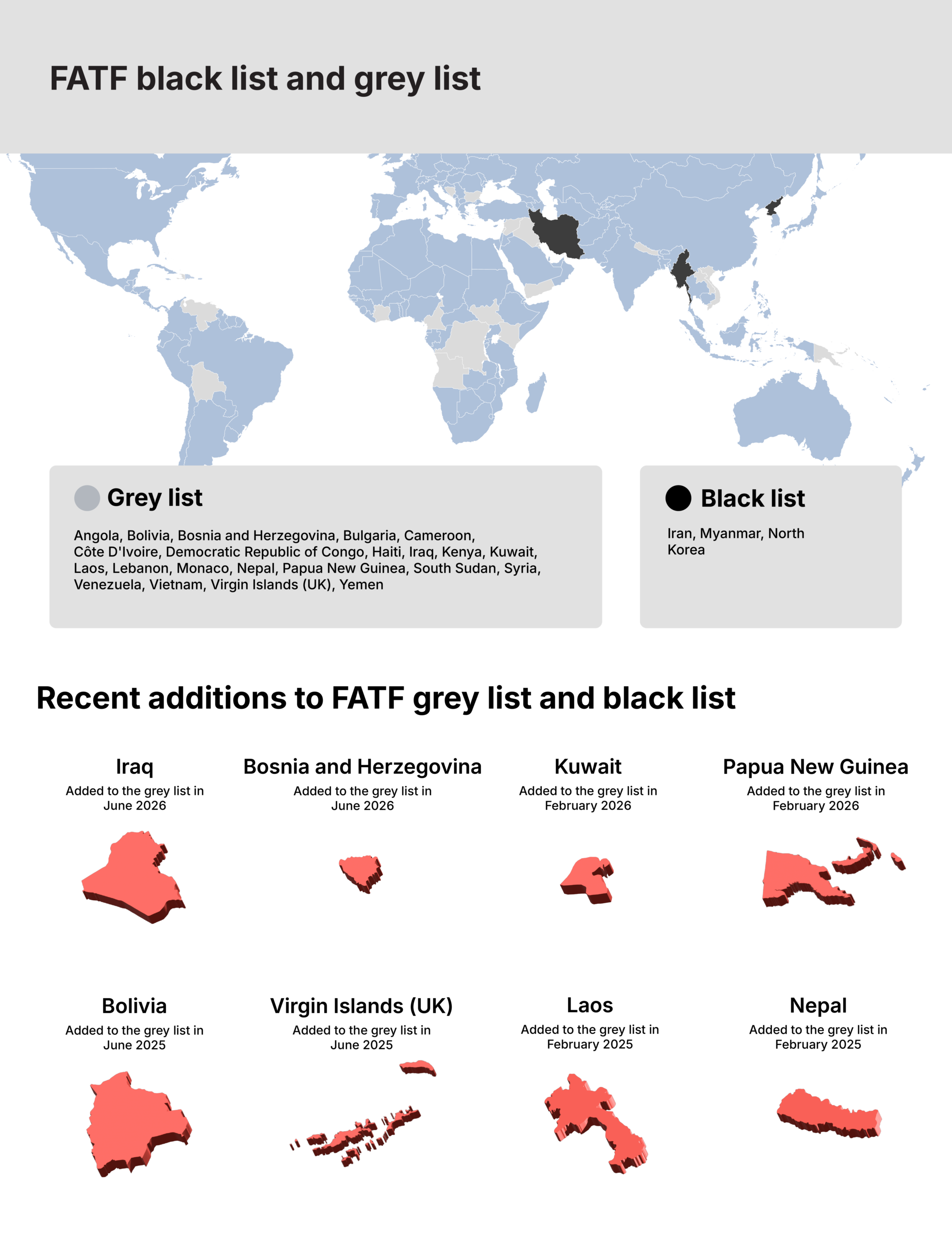
The grey list after the October 2026 plenary:
Angola, Bolivia, Bosnia and Herzegovina, Cameroon, Haiti, Iraq, Kenya, Kuwait, Laos, Lebanon, Nepal, Papua New Guinea, South Sudan, Syria, Venezuela, Vietnam, the Virgin Islands (UK), and Yemen.
2. The black list: No changes, with updated statements on Iran and Myanmar
The list of high-risk jurisdictions subject to a call for action, often called the black list, still includes the DPRK, Iran, and Myanmar. Given heightened proliferation financing risks, the FATF reiterated its call to apply countermeasures to the DPRK and Iran.
Iran gave the FATF an update in September 2026. The FATF said Iran has made limited progress on technical compliance, including developing a framework to receive international asset-freezing requests, but that its regime still has fundamental deficiencies. In particular, Iran’s legal framework does not adequately criminalize terrorist financing or establish a targeted financial sanctions regime in line with the FATF Standards.
Myanmar remains subject to enhanced due diligence (EDD) rather than countermeasures. The FATF said it will consider countermeasures if no further progress is made by February 2027. It also reiterated its call on Myanmar to address the illicit finance risks linked to fraud and cyber scam activity, which it described as extensive. The FATF acknowledged some steps, including plans for a national anti-online scams center and stronger regional and international co-operation.
A Guide to the FATF Grey List
The FATF grey list is among the best-known indices of higher-risk countries in the compliance industry. But how should firms respond to a grey listing in practice?
Download now3. Strategic initiatives
Two strategic initiatives from this plenary are directly relevant to firms with exposure to crypto and to cross-border scam activity.
Accelerating implementation of the FATF Standards on virtual assets
Responding to the FATF Ministerial Declaration of April 2026, the plenary agreed to speed up implementation of the FATF Standards on virtual assets in jurisdictions with materially important virtual asset activity. Criminal networks increasingly use virtual assets for fraud, scams, sanctions evasion, money laundering, terrorist financing, and proliferation financing.
The FATF will launch a new targeted review, based on objective criteria, with accelerated follow-up processes to help jurisdictions close gaps faster. The results will be published in June and October 2027. Alongside the review, the FATF plans to engage in ongoing training and capacity-building with the jurisdictions involved.
Combating illicit financial flows linked to scam compounds
The plenary approved a new report on the end-to-end illicit financial flows linked to scam compounds, which the FATF describes as among the most rapidly expanding forms of organized crime globally. The report draws on operational insights from across the FATF Global Network to help authorities dismantle the criminal business models and crime-as-a-service economy behind scam compounds.
The FATF said the report will be published in the week after the plenary. It is the first output of the FATF’s roadmap on combating fraud under the UK Presidency and will be followed by a wider study on how the FATF’s toolkit can be used against fraud more broadly.
4. Mutual evaluations of Mexico and the United States
The plenary adopted the FATF-GAFILAT mutual evaluation of Mexico and the FATF-APG-CFATF mutual evaluation of the United States. Both reports assess how effectively each country combats money laundering, terrorist financing, and proliferation financing, and how well it complies with the FATF Recommendations.
The reports will be published in December 2026, after a quality and consistency review. Under the new round of mutual evaluations, each country receives a time-bound Roadmap of Key Recommended Actions to complete within three years.
5. A proportionate, risk-based approach
Tailored assessments for low-capacity countries
The plenary concluded a project on the challenges low-capacity countries face in building effective AML/CFT/CPF frameworks. In response, the FATF will introduce a more tailored approach to mutual evaluations for a subset of developing countries, improve training for assessors to promote a more risk-based approach, and support dialogue on effective capacity building.
A Learning and Development Forum on the risk-based approach
The FATF will host a Learning and Development Forum in Dallas, Texas, on December 1-2, 2026. It will bring together supervisors, FIUs, law enforcement, financial institutions, and non-financial institutions to work toward a concrete policy statement on how the risk-based approach (RBA) should be implemented in practice. The FATF plans to publish the statement shortly after the forum.
6. The Global Network and membership
This was the first plenary under the UK Presidency of Giles Thomson. Fraud and scam compounds, the risk-based approach, and information sharing were set out as UK Presidency priorities in June 2026, and the scam compounds report and Dallas forum are the first concrete steps on two of them.
Through the FATF Guest Initiative, Barbados, Namibia, and Thailand participated under their own flags for the first time. The suspension of the Russian Federation’s FATF membership remains in place.
Next steps
- Country risk assessments: Firms should update country risk ratings for Bulgaria, Côte d’Ivoire, the Democratic Republic of the Congo, and Monaco in line with their own risk-based methodology. Removal from the grey list doesn’t automatically mean low risk.
- Vietnam and Myanmar exposure: Both face deadlines in February 2027. Firms with customers, counterparties, or payment flows linked to either should review whether their current due diligence measures are proportionate.
- Virtual asset exposure: Firms that work with VASPs or operate in jurisdictions with large virtual asset sectors should expect closer scrutiny as the targeted review begins in 2027.
- Scam compound typologies: The FATF’s upcoming report should give compliance teams new red flags to test against their transaction monitoring rules and screening processes.
The next FATF plenary is expected in February 2027.
FATF plenary October 2026’s FAQs
Which countries were removed from the FATF grey list in October 2026?
Bulgaria, Côte d’Ivoire, the Democratic Republic of the Congo, and Monaco were removed from the list of jurisdictions under increased monitoring on October 30, 2026, after completing their action plans.
Were any countries added to the FATF grey list in October 2026?
No. The October 2026 plenary did not add any jurisdictions to the grey list, which now includes 18 jurisdictions.
Which countries are on the FATF black list?
The DPRK, Iran, and Myanmar remain on the list of high-risk jurisdictions subject to a call for action. The FATF calls for countermeasures against the DPRK and Iran, and enhanced due diligence for Myanmar.
What did the FATF say about Vietnam?
The FATF expressed significant concern about Vietnam’s pace of progress and its failure to complete its action plan. It expects tangible improvements by February 2027, or it will consider next steps.
When is the next FATF plenary?
The next plenary is expected in February 2027.
The State of Financial Crime 2026
Get insights on financial crime trends from our global survey of 600 senior decision-makers, with expert guidance from our Financial Crime Compliance Strategy team.
Download nowOriginally published 30 October 2026, updated 30 October 2026
Disclaimer: This is for general information only. The information presented does not constitute legal advice. ComplyAdvantage accepts no responsibility for any information contained herein and disclaims and excludes any liability in respect of the contents or for action taken based on this information.
Copyright © 2026 IVXS UK Limited (trading as ComplyAdvantage).