
- Insights
- Featured Insights
Almost every financial institution has a budget for AI, yet far fewer have it running. According to ComplyAdvantage’s State of Financial Crime 2026 research, 99% of organizations have dedicated projects or budgets for AI in financial crime detection, but only a third have an agentic solution live for screening or transaction monitoring.
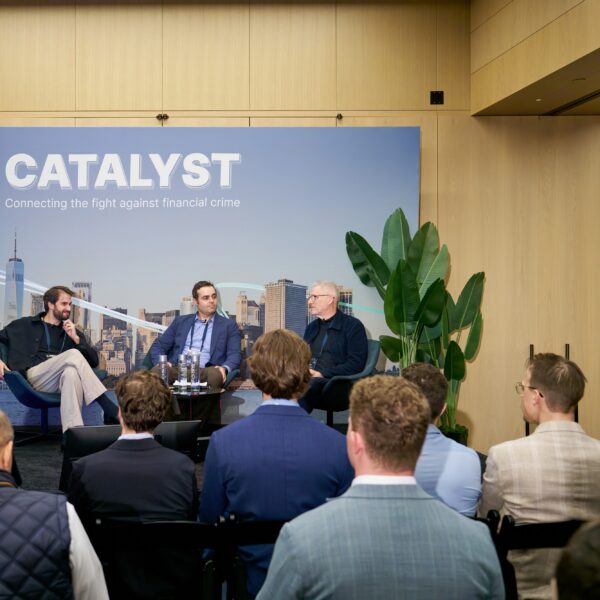
At ComplyAdvantage’s CATALYST New York event on November 5, 2026, Mark Watson, Chief Product and Technology Officer, asked two guests to explore the gap: Greg Capece, Managing Director at EY, who advises banks, fintechs, and crypto firms on AI programs, and Pedro Sanzovo, GM and Head of Fraud at Plaid. Both agreed: the data the model reasons over and the controls around it decide the outcome.
Why AI pilots stall
AI adoption varies by institution. Fintechs and crypto firms tend to move fastest because they carry less legacy technology to unwind; regional banks are limited by capacity; and the largest institutions move most cautiously, with many building their own AI solutions. Three blockers recur between pilot and production: data, technical capability (including the build-versus-buy decision), and governance.
“Where we’ve seen pilots successfully make it to production, the firms got the data right, they got the technology right, and they had a clear path through governance. ”
– Greg Capece, Managing Director, EY
Cheap fraud, expensive data
AI has changed the economics on the attacker’s side. A fake document or a deepfake can now be produced both quickly and cheaply, which is why document and live checks no longer carry the weight they once did. First-party fraud has grown alongside it: credit bust-outs, promo abuse, and friendly fraud through chargebacks and ACH returns. It is no longer only about hiding an identity, but intent.
Plaid’s identity verification data shows more fraud attempts per identity and more new fraudulent identities trying to get through. Relying on data is costly to fake. In an adversarial market, any signal that looks high-assurance today becomes a target, so the data worth trusting changes over time. A document is cheap to forge. A bank account with years of real activity is not.
“For a fraudster to create a bank account, farm the bank account, run multiple legitimate transactions through it … over years, it becomes really expensive. It’s doable. It’s really, really expensive.”
– Pedro Sanzovo, GM and Head of Fraud, Plaid
No single source settles it, though. The work is connecting signals into a graph that tells a story.
“I don’t think that any single data asset that we leverage is a silver bullet.”
– Pedro Sanzovo, GM and Head of Fraud, Plaid
Govern by consequence
Most agentic deployments today sit in operations: collecting and summarizing information, recommending decisions, and drafting narratives. Agents can also surface patterns nobody asked them to look for. For example, they can work a complex transaction-monitoring case and flag high-risk money-order activity near the southwest border that they had not been instructed to look for.
That capability is why governance should scale with what an agent is allowed to do. Our research found that North American respondents were the least inclined among regions to favor an innovation-led approach to AI regulation.
“The banks want to know how they are going to be examined. That’s really what it comes down to. […] Banks are very hesitant to change what they’re doing now, unless they know exactly what’s going to be in that examination manual.”
– Greg Capece, Managing Director, EY
Long memories drive some of this. Institutions building AI strategy want programs that outlast current guidance and current administrations.
“If you get audited five years from now, can you stand behind the decisions that you’ve made?”
– Greg Capece, Managing Director, EY
That made the timing useful. The day before the session, the U.S. Office of the Comptroller of the Currency (OCC) issued its Super Intelligence: Supervisory Framework (Bulletin 2026-54), which takes its name from the administration’s term for AI. The framework gives examiners a way to assess banks’ use of generative and agentic AI.
It builds on existing model risk, governance, and operational-risk practices and does not treat AI as a separate risk category. Generative models are non-deterministic, which makes repeatability a test in its own right. Validation, tuning, and ongoing monitoring still apply.
“One successful run doesn’t necessarily mean it’s successful. You need to be able to demonstrate that over time you’re going to get the results that you want.”
– Greg Capece, Managing Director, EY
What compliance can learn from fraud
Fraud teams operate on one habit that compliance can adopt – letting data lead.
“In the fraud world, we are guided by data.”
– Pedro Sanzovo, GM and Head of Fraud, Plaid
Which leads to three practical takeaways:
- Define performance: Start with a clear definition of what good looks like before choosing the tool.
- Count both sides of the error: Track false positives and false negatives alongside true positives and true negatives, and put a cost on each.
- Close the feedback loop: Collect outcomes and learn from them, so that approval and false-positive rates move in the direction you want.
“What is the cost of a false positive? You’ve got to be able to measure that.”
– Pedro Sanzovo, GM and Head of Fraud, Plaid
Fraud shows what to measure, and the regulatory direction shows why it matters. Whichever side of financial crime a team sits on, AI delivers only as far as the data it relies on can be trusted and measured.
Watch CATALYST New York on demand
What do a scam, a laundering operation, and a sanctions breach have in common? They run on the same money, exploit the same accounts, and profit from the exact same blind spot: detection systems built to catch them in isolation. Watch the full New York program on demand, alongside compliance professionals from around the world.
Watch nowOriginally published 18 November 2026, updated 18 November 2026
Disclaimer: This is for general information only. The information presented does not constitute legal advice. ComplyAdvantage accepts no responsibility for any information contained herein and disclaims and excludes any liability in respect of the contents or for action taken based on this information.
Copyright © 2026 IVXS UK Limited (trading as ComplyAdvantage).