

- Insights
- Featured Insights
For senior compliance decision-makers, selecting the right anti-money laundering (AML) data vendor goes far beyond ticking regulatory boxes. The decision is increasingly about operational efficiency, ensuring data integration across systems, and providing the intelligence to transform compliance workflows. With financial crime risks evolving rapidly and regulatory expectations tightening, the need for a data provider that can not only meet current obligations but also future-proof compliance efforts is paramount.
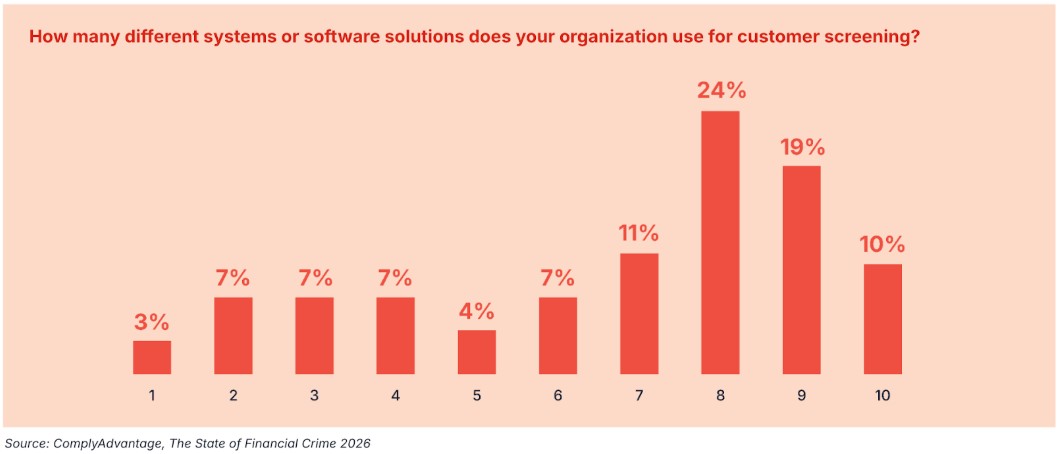
This means assessing more than just data coverage. It involves evaluating the ability to streamline complex processes and minimize operational bottlenecks. With the vast majority of firms (97%) relying on two or more solutions for customer screening – and 53% managing between eight and 10 separate systems – compliance teams are often overwhelmed by siloed tools and fragmented data sources.
For financial institutions (FIs) struggling with disjointed systems, high false positive rates, and inefficient manual reviews, the right vendor can help shift the focus from reactive compliance to proactive risk management.
This article will explore the four core factors that senior compliance officers should prioritize when evaluating AML data vendors.
What is an AML data vendor?
AML data vendors are specialized providers of information used to identify and mitigate financial crime risks. Their primary role is to supply the data necessary for compliance tools to function effectively, but it’s important to note that not all vendors provide the same level of service or data comprehensiveness.
Many AML screening tools depend on third-party data vendors to deliver various data types, which may include information on:
- Sanctions and watchlists: Data on individuals, entities, and jurisdictions subject to international sanctions.
- Politically exposed persons (PEPs): Profiles of individuals in positions of political influence, including relatives and close associates (RCAs).
- Adverse media: Negative news articles that highlight potential risks associated with an individual or entity.
Why choosing the right data vendor is important in AML
While some AML data vendors focus on specific types of information, others offer broader datasets that address multiple risk categories. However, in many cases, these datasets are provided as standalone products. This means FIs must integrate the data with separate screening tools to conduct risk assessments.
However, this fragmented approach often creates significant challenges. Since the rules engines and the data sets are not inherently designed to work together, discrepancies can arise. For instance, a rules engine might apply logic or matching criteria that don’t fully align with the structure, attributes, or coverage of the data being used. This misalignment leads to inefficiencies, such as higher false positive rates, which require compliance teams to spend more time on manual reviews. It can also create blind spots where potential risks go undetected because the logic isn’t optimized for the data.
What sets ComplyAdvantage apart is its ability to combine its proprietary data with a fully integrated solution, offering a software-as-a-service (SaaS) model that tightly couples:
- Proprietary data: Consistently updated and high-quality data.
- AI and logic: Advanced algorithms tailored to their data for more accurate results.
- UI/API delivery: Seamless, user-friendly interfaces and integrations for better operational efficiency.
By choosing this model, firms can avoid the challenges of disjointed systems and benefit from higher accuracy, reduced false positives, and faster compliance workflows.
Core considerations when assessing AML data vendors
1. Prioritize unified, consolidated risk profiles
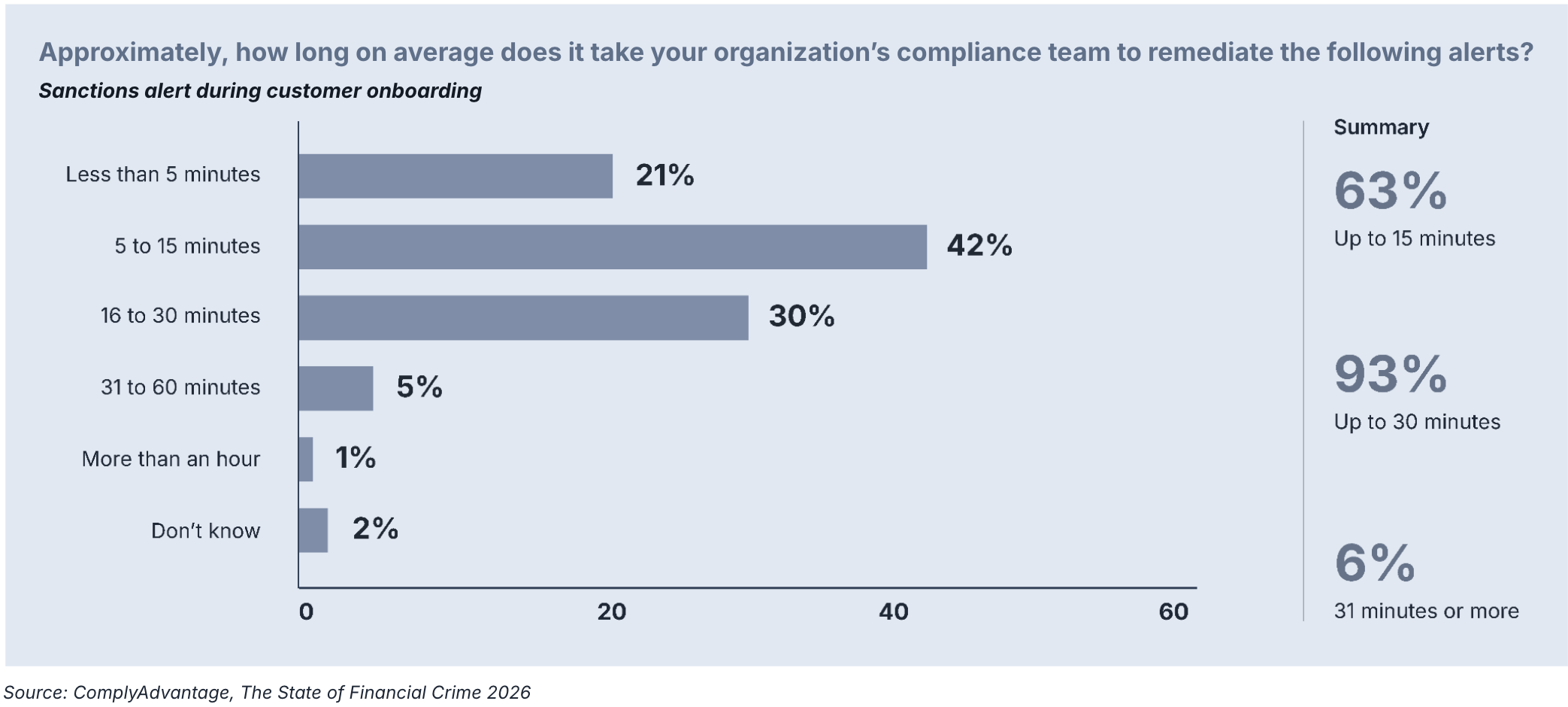
Effective compliance starts with a clear and comprehensive understanding of the entity being screened. Fragmented data systems make this challenging, often presenting analysts with partial or conflicting profiles. This inefficiency has a measurable impact: our research shows that nearly 8 in 10 organizations (79%) take more than five minutes to clear a single sanctions alert during the critical customer onboarding phase. Consolidating risk information into a unified profile is key to improving both the accuracy and speed of these decisions.
A consolidated profile enables FIs to view all available information about an individual or entity – such as sanctions status, PEP connections, and adverse media – within a single, integrated system. This not only saves time but ensures risk factors are assessed holistically rather than in silos. Without this unification, key details might be overlooked or misinterpreted, potentially leading to costly compliance failures.
Another critical advantage of consolidated profiles is their ability to streamline workflows. Instead of dealing with mismatched data or reconciling duplicate records, analysts can focus on identifying true risks. For example, a unified system reduces the chances of duplicate alerts caused by minor variations in data entries, such as different spellings or formatting of names across datasets.
2. Look for continuous learning and improvement
Effective AML compliance requires constant adaptation to emerging risks and regulatory changes. A vendor that prioritizes continuous learning and improvement is invaluable in this environment. Many data providers simply supply static datasets, but the most effective vendors incorporate feedback loops to refine and enhance their data and algorithms over time.
One key differentiator is a vendor’s ability to use remediation data from its clients. This data – including decisions about false positives or identifying true risks – can be fed back into the system to improve both the underlying data quality and the search algorithms. For instance, if an analyst flags a profile as a false positive due to duplicate entries, this feedback helps the vendor refine its entity resolution algorithms, reducing future false positives.
Every decision a client makes – whether it’s marking something as a false positive or confirming a true match – may become training data. At ComplyAdvantage, this feedback loop allows us to identify gaps in coverage, refine entity resolution, and improve search algorithms in alignment with our contractual obligations. It’s continuous improvement, every day, learning from client decisions.
Dan Humphry, Staff Product Manager at ComplyAdvantage
3. Choose vendors with flexible, scalable data architectures
Firms should ensure the AML vendor’s system can scale and adapt as data requirements and regulatory landscapes evolve. Rigid, outdated architectures – such as those that purely rely on flat file uploads, like spreadsheets – can lead to limitations in functionality and hinder the integration of new data points. A flexible architecture allows for seamless integration with various data sources, which is essential for building a comprehensive and unified risk profile.
Another key benefit of a flexible architecture is the ability to support real-time updates. FIs need access to the most current data to assess risks accurately. A scalable architecture ensures updates to risk data, whether through sanctions list changes or new regulatory guidelines, are integrated smoothly and swiftly, minimizing the lag between data changes and system updates.
4. Ensure clear data lineage and transparency
Clear data lineage is a vital consideration when assessing AML data vendors. FIs need to know exactly where each data point originates, how it has been processed, and whether it has been validated. This transparency ensures data accuracy, strengthens internal audit capabilities, and supports informed decision-making.
Vendors that offer full data lineage can provide details such as the source of a data point, the date it was ingested, and any steps taken to verify or update it. This is especially critical in risk screening processes, where decisions often hinge on the reliability of specific data attributes, like dates of birth or associated entities.
In contrast, many traditional systems rely on flat files that lack robust attribution details. Without clear timestamps or source information, firms face challenges in reconciling discrepancies or understanding why specific risks were flagged. These limitations can lead to inefficiencies and make it difficult to identify and correct gaps in coverage.
Enhance financial crime detection with ComplyAdvantage
At ComplyAdvantage, we recognize how crucial it is to utilize high-quality data to improve AML efficiency and reduce false positives. But we also know the frustrations that go alongside partnering with multiple vendors for different data sets and separate screening tools. Disparate systems will never give firms the single consolidated profiles they need to efficiently screen their customers and mitigate risk. This is why we offer a SaaS-based, AI-native risk intelligence platform that unites global intelligence to help firms meet their regulatory obligations, minimize unnecessary manual interventions, and enhance the effectiveness of their AML programs as a whole.
Here’s how our proprietary data can make a difference:
- Fewer false positives: Our award-winning machine learning model analyzes global distributions of names and other identifiers, allowing us to maximize true matches while minimizing false positives.
- Faster remediation: We provide detailed, rich profiles that consolidate identifying information from global sources. This enables firms to discount false positives and confidently confirm true positives swiftly.
- Timely and comprehensive risk coverage: ComplyAdvantage offers one of the fastest sanctions data update processes available. Our consolidated entity profiles are continuously refreshed, ensuring clients have access to the latest and most relevant data as soon as it becomes available.
- Improved risk-association detection: Our solutions extend beyond basic screening. We continuously gather data on family connections, corporate structures, and trading relationships from various global sources. This capability helps clients detect risks associated with indirect sanctions evasion or connections to PEPs and their RCAs. By doing so, we empower our clients to stay ahead of emerging threats and make informed decisions.
Get a 360-degree view of financial crime risk with ComplyAdvantage Mesh
A cloud-based compliance platform, ComplyAdvantage Mesh combines industry-leading AML risk intelligence with actionable risk signals to screen customers and monitor their behavior in near real time.
Get a demoOriginally published 16 April 2026, updated 16 April 2026
Disclaimer: This is for general information only. The information presented does not constitute legal advice. ComplyAdvantage accepts no responsibility for any information contained herein and disclaims and excludes any liability in respect of the contents or for action taken based on this information.
Copyright © 2026 IVXS UK Limited (trading as ComplyAdvantage).